
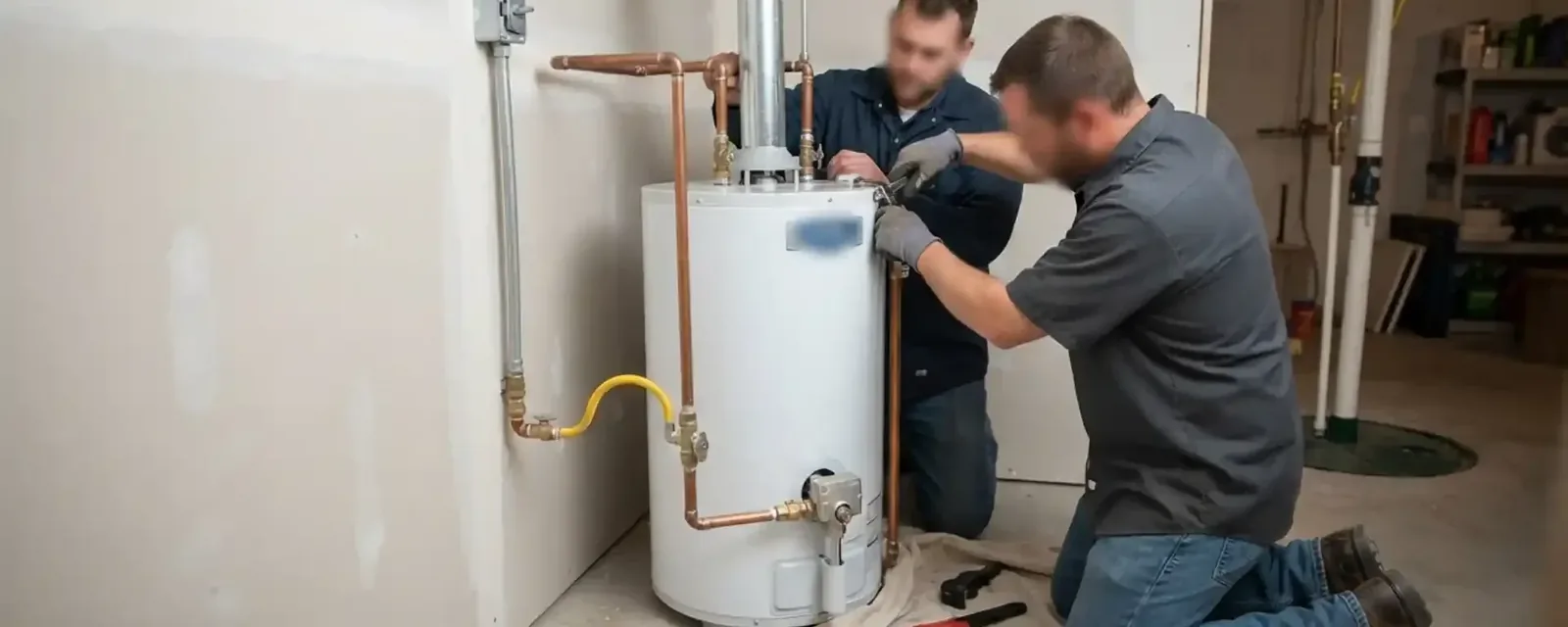
Water heater installation is the first-time setting of a heater in a new spot: a new house, an addition, a finished basement, or a unit moved to a better location. It is a planning job as much as a plumbing job, since fuel supply, vent path, drain access and permits all have to line up before the heater arrives. Our licensed plumbers walk through those choices with you.
If your heater has already failed and you need a swap, the water heater replacement page is the better fit. This page covers the planning side: what the building must provide, what the code asks for, and how the job unfolds.
Decide the location before the framing is done
Where the heater sits drives everything else. A closet near the bathrooms shortens hot water waits. A basement corner makes draining and venting easier but may sit lower than the lowest drain, which affects how the pan and relief pipe terminate.
In new construction and remodels, the cheapest time to choose is before drywall. Moving a gas line, vent or drain after finishes go up costs far more in patching than in plumbing. Tell us your plans early and we mark the rough-in points.
Gas, electric or heat pump: what the building must supply
Each fuel puts different demands on the structure.
| Type | Needs | Watch for |
|---|---|---|
| Natural gas tank | Gas line, flue, combustion air | Undersized line, poor flue slope. |
| Electric tank | Dedicated circuit, panel space | A crowded panel needing upgrade. |
| Heat pump hybrid | Circuit, condensate drain, airflow | Cool exhaust air, noise, ceiling height. |
| Gas tankless | Larger gas line, special vent | Venting upgrade and descaling. |
Electric circuit sizing and panel work belong to a licensed electrician. We coordinate with yours, but we do not do that portion. If you want endless hot water instead of a tank, read about tankless water heaters first.
Venting, direct vent and condensate
Gas heaters can vent in a few ways. Atmospheric units use a flue that rises by natural draft. Power-vent and direct-vent units use a fan and run through a wall, often with a separate intake. Condensing units produce acidic condensate that must drain to a proper receptor.
Pick the vent type first, because it sets where the heater can go. A direct-vent model lets you place it in a utility room with no chimney, while an atmospheric one needs a clean flue path and enough combustion air. Seasonal homes in Belmar and Bradley Beach often sit unused for weeks, so a vent you can inspect easily is worth the planning.
Tank failing today?
If the heater has already failed, we handle same-day swaps when available.
Fittings that belong on every new install
These parts are cheap next to the heater, and skipping them shows up as leaks or complaints later.
Expansion tank
On a closed system, hot water has nowhere to expand. The tank absorbs the pressure rise that would otherwise stress the T&P valve.
Thermostatic mixing valve
It blends hot and cold at the outlet so you can store water hot and deliver it safely.
Drain pan and pipe
A pan with a drain line limits damage when a tank eventually weeps.
T&P discharge pipe
The relief valve needs a full-size pipe that ends where hot water cannot hurt anyone.
Shutoff and union fittings
A reachable valve and unions make future service a thirty-minute task instead of a cutting job.
Permits and the three inspection stages
Permit rules vary, so ask the Neptune Township construction office what your installation needs. The township's 2018 fee schedule lists $27 per fixture or device, including water heaters up to 99 gallons, and $65 for a heater of 100 gallons and up. Confirm current fees with the office.
For one and two family dwellings, the township lists rough plumbing, finish plumbing and final plumbing inspections. Rough happens before piping is covered, finish covers trim and fixtures, and final closes the job. Inspections must be requested at least 24 hours ahead, and the township performs them within three business days of the requested time.
A job day from start to finish
A new install runs differently from a swap, because the supply lines and vent may be new work.
Confirm the rough-in
We verify supply lines, gas stub, circuit and vent opening are where the plan says.
Set the pan and heater
The unit goes on a level base with the pan and drain line connected first.
Connect water and fuel
We run supply lines, install the expansion tank and mixing valve, and test gas joints.
Vent and relieve
Flue or direct-vent pipe is sealed and pitched, and the relief discharge pipe is run.
Fill, fire and walk through
We purge air, check every joint, light or energize the heater, and set the temperature.
Specify for Neptune's water
New Jersey American Water reports naturally occurring hardness of 72 to 140 ppm in its Coastal North system, which includes Neptune Township. That is about 4 to 8 grains per gallon, and your street may sit anywhere in that range.
Plan for it during installation. Ask for a drain valve you can reach, a clear space for flushing and a heater with an anode rod you can inspect. Those decisions cost almost nothing now and help every year after.
Relocating a heater takes more than moving the tank
Moving a heater means new supply and return runs, a new vent route, possibly a new gas line and a revised drain. The old location also needs its pipes capped or removed. If you plan a remodel that moves bathrooms, share the plan so we can place the heater near the loads it serves. Moving a bathroom too? Our plumbing installation page covers fixture rough-in.
Questions to ask any installer
Use this list on the phone, with us or anyone else.
- Are your plumbers licensed in New Jersey? You can verify any plumber on the state's online License Verification System.
- Who pulls the permit, and who schedules the inspections?
- How will you size the unit and what first-hour rating do you recommend?
- What happens with the vent: reuse, reroute or replace?
- Will you install an expansion tank, drain pan and mixing valve?
- Is the price clear before work starts, and what could change it?
What shapes the cost of a new installation
Installation prices vary more than swap prices because new work carries more unknowns.
Installation is usually a planned project, not an insurance claim. If a remodel is covered through a claim, we can provide an itemized invoice for the adjuster.
Water Heater Installation questions in Neptune, NJ
Yes. We plan the location, supply and drain runs, vent path and fuel supply with you, then pull the right permits. Tell us early so we can mark rough-in points before drywall.
Choose what the building already supplies, unless you plan to run new service anyway. Gas recovers faster and needs a flue. Electric needs a dedicated circuit and has no combustion.
If you are weighing a heat pump unit, it needs space for airflow and a condensate drain, so check the room first.
The township lists them for one and two family dwellings. Rough plumbing covers piping before it is covered, finish covers piping, trim and fixtures, and final closes the job. Ask the Neptune Township construction office which apply to your project, since permit rules vary.
The township's 2018 fee schedule lists $27 per fixture or device, including water heaters up to 99 gallons, and $65 for a heater of 100 gallons and up. There is also a $95 minimum per subcode. Confirm current fees with the office.
On a closed system with a backflow preventer or pressure reducing valve, an expansion tank is generally needed to handle thermal expansion. A mixing valve is a smart safety add-on whenever you store water near the top of the 120 to 140 degree F range. We check both during planning.
Decide the heater location per unit, confirm the fuel and meter arrangement, and ask about sizing for the expected tenants. Keep permit and inspection records with the property file.
We can coordinate with a property manager on access and scheduling, and send clear paperwork for each install.
Related plumbing services
Sources referenced on this page: New Jersey American Water, Coastal North annual water quality report. Neptune Township construction office, 2018 fee schedule (Ordinance 18-25). NJ Division of Consumer Affairs, License Verification System.