
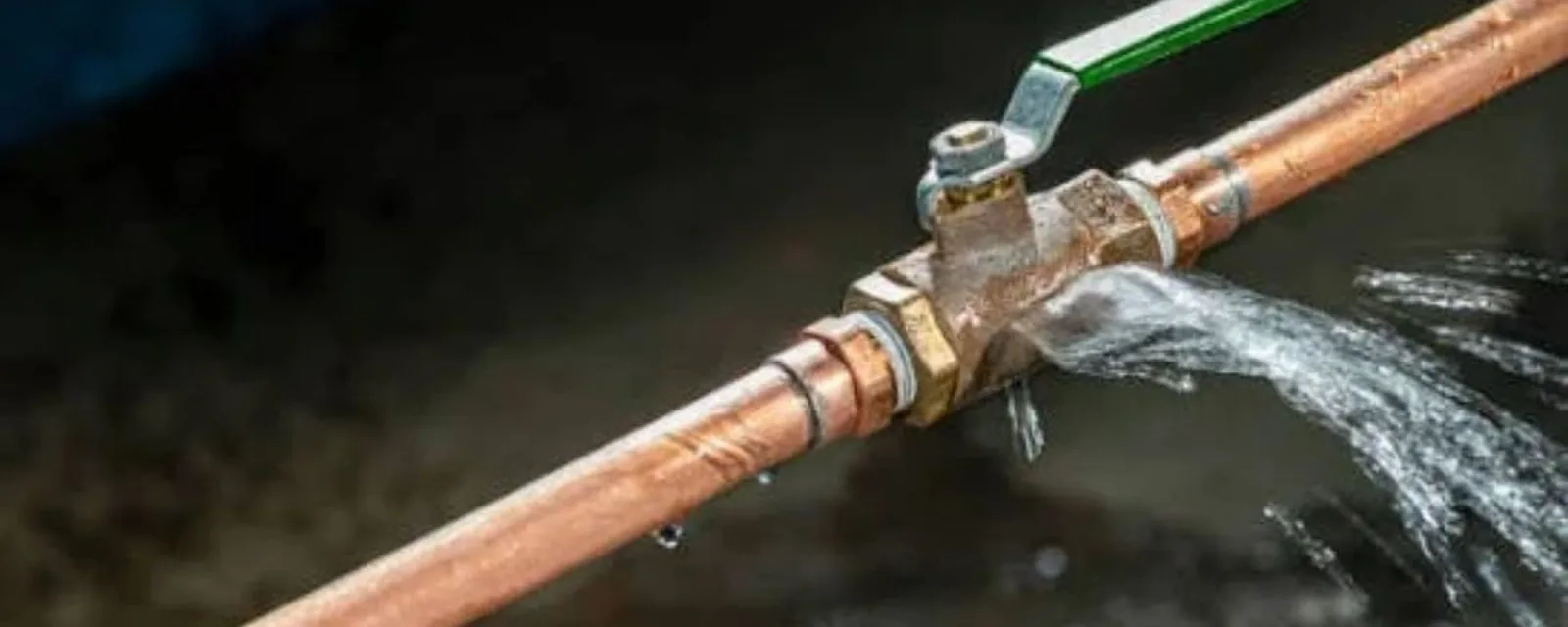
A burst pipe is a supply line that has split, cracked or blown a joint, so water leaves the system faster than any drain can carry it. It can happen with no warning in a basement wall, an attic run or a crawl space. Shut off the main valve first, then call the 24/7 emergency line at (732) 466-1098. Switch off power to wet areas only from a dry spot, and never stand in water near a panel.
Once the water is off, the job is to find the failed section, repair it so the line holds under pressure, and look for a cause that could split the next one. Licensed plumbers handle the repair, and you get a clear price before work starts.
Water spraying or flooding a room? Shut it off first
The main shutoff is commonly near the water meter or where the service line enters the house, often on a basement or utility room wall. Turn the handle clockwise until it stops. A lever handle closes with a quarter turn. Then open the lowest faucet in the house to drain the remaining pressure.
Next, keep people away from wet outlets, power strips and the electrical panel. If the panel sits in water, do not touch it and call us and the electric utility. If you smell gas, leave the building and call the gas utility or 911 before you call a plumber.
Frozen but not burst yet: thaw it safely
If a faucet gives only a trickle in cold weather, the pipe behind it may be frozen. Open that faucet, then warm the pipe slowly with a hair dryer or warm towels, working from the faucet end back toward the frozen section. Never use a torch or any open flame. Flame can ignite framing and can damage solder joints.
Stop and call if you see a bulge, a split, a crack in the pipe or water appearing as it warms. Ice can seal a split, so the pipe may start to leak as it thaws. A pipe that froze once will freeze again unless its location or insulation changes.
Why pipes split
Knowing the cause decides whether a short repair is enough or the whole run needs attention.
Freezing
Ice expands and the pipe splits where it swells, often along a seam, not at the frozen spot itself.
Corrosion and pinholes
Old galvanized and thin copper wear from the inside until a spot gives way under normal pressure.
High water pressure
Pressure above what fittings are built for fatigues joints. A failed pressure reducing valve is a common culprit.
Failed joints
Bad solder, a dry fitting or a worn clamp lets go long after install, usually at a bend or valve.
Storm and movement
Shifting soil, a fallen tree or flood debris can pull a line apart where it enters the building.
Know your main shutoff
Finding the valve now saves minutes when a pipe lets go.
Repair options by pipe material
The right fix follows the material, the split location and how many other weak spots the line has.
| Pipe | How it fails | Repair | Trade-off |
|---|---|---|---|
| Copper | Freeze split or pinhole | Cut out the section and sweat in new pipe | Needs dry pipe and heat, so water must be fully off. |
| PEX | Freeze swelling or a bad fitting | Cut and use a crimped or expansion coupling | Quick, but a PEX run with many fittings may deserve a full look. |
| Galvanized steel | Rust-through, threaded joint leaks | Replace the section with new pipe | Neighboring sections are often thin too. |
| CPVC | Brittle cracks at fittings | Replace the fitting or section | Old CPVC may split again nearby. |
| Supply stub or valve | Cracked body or stripped threads | Replace valve or stub-out | Easy to do, yet the wall may need access. |
If a line has failed twice in different places, patching starts to cost more than it saves. That is the point to talk about repiping the failing run or the whole house.
Empty and seasonal houses: the quiet burst
A pipe that splits in an empty house runs until someone notices. Nearby shore boroughs show how common that setup is. Belmar had 29.5% of its housing units vacant and Bradley Beach 33.0% in the 2020 figures, which points to many seasonal and second homes along this stretch of coast.
If your house sits empty in winter, shutting the main valve and draining the lines before you leave costs minutes and prevents most of this damage. We can show you the valve location and the drain-down order. Owners in Bradley Beach and Belmar ask about this most often.
After a storm or flood
Flood water is not a plumbing leak, but it can crack lines, pull fixtures loose and wreck water heaters and controls. Superstorm Sandy left parts of Shark River Hills, Ocean Grove and North Island heavily damaged, and the township's flood zone maps (AE, AO, VE and X) cover large residential areas.
If your property sits in one of those zones, treat any storm as a reason to check the main valve, the meter connection and low piping afterward. Do not turn the power back on yourself if water reached outlets or the panel. Have it cleared by an electrician first.
Document it for your insurer or landlord
Claims move faster with a record. Do this while the water is still being stopped.
- Photograph and film the pipe, the water source and every wet room before cleanup.
- Write the time you found it and when you shut the main valve.
- Keep the damaged pipe section if we cut it out.
- List damaged items with rough age and where each sat.
- Save all invoices and receipts, including drying equipment.
- Tenants: send the landlord or property manager a written notice the same day.
Many policies cover sudden bursts but handle gradual leaks differently, so call your insurer before large repairs begin.
Keeping the next freeze from becoming a flood
These steps cost little and address the usual weak points.
- Insulate pipes in exterior walls, attics, crawl spaces and garages.
- Seal air leaks around where pipes pass through walls and sills.
- Open cabinet doors under sinks on exterior walls during a cold snap.
- Let a faucet drip on the farthest run in extreme cold.
- Disconnect hoses and shut off the supply to outdoor spigots.
- Know where the main valve is and test that it turns.
Permits and inspections after a burst
A short repair may not need a permit, but replacing runs of pipe might. Permit rules vary, so ask the Neptune Township construction office. The township's 2018 fee schedule lists $27 per plumbing fixture or device and a $95 minimum per subcode, and the office confirms current fees.
When piping is opened, rough plumbing is inspected before it is covered. The township asks for at least 24 hours of notice and says it performs inspections within three business days of the requested time. Plan wall repair after that visit. Work follows the National Standard Plumbing Code, NJ edition.
What a burst pipe repair costs depends on
Two burst pipes can differ a great deal in cost. These are the factors we weigh when we quote.
Home insurance often covers the damage a burst causes but not always the pipe itself. Ask your insurer before work and keep every invoice.
Burst Pipe Repair questions in Neptune, NJ
Yes. The 24/7 emergency line at (732) 466-1098 is open around the clock, and burst pipes are among the calls we take most seriously at any hour.
While you wait, close the main shutoff, open the lowest faucet, keep clear of wet electrical areas and photograph everything. We do not promise an arrival time, but we will tell you exactly what to do next.
Usually where the water line enters the house, often on a basement wall, or near the meter. Some homes also have a curb valve outside. Find it before an emergency and make sure it turns.
A hair dryer or warm towels, applied slowly from the faucet end, are safe options with that faucet open. Never use a torch or open flame. If the pipe is bulging, cracked or in a wall you cannot reach, call us.
Permit rules vary, so ask the Neptune Township construction office. The township's 2018 fee schedule lists $27 per fixture or device and a $95 minimum per subcode, and the office can confirm current fees.
The lease and the cause decide who pays. Tell your landlord or property manager in writing right away, shut off the water if you can, and document the damage. If the water cannot wait, call us and we will give the landlord an itemized invoice.
Not if the cause is removed. A freeze split needs insulation or relocation, a pressure problem needs a working pressure reducing valve, and an old failing line may call for leak detection on the rest of the system to see what else is weak.
A split on the buried service is a different repair involving the utility and the curb. See water service line repair. Ask your water bill's customer service about who owns which section.
Related plumbing services
Sources referenced on this page: New Jersey Department of Community Affairs, plumbing subcode (N.J.A.C. 5:23-3.15), National Standard Plumbing Code. Neptune Township construction office, 2018 fee schedule (Ordinance 18-25). NJ Department of Community Affairs, Strategic Recovery Planning Report on Neptune Township (2014).