
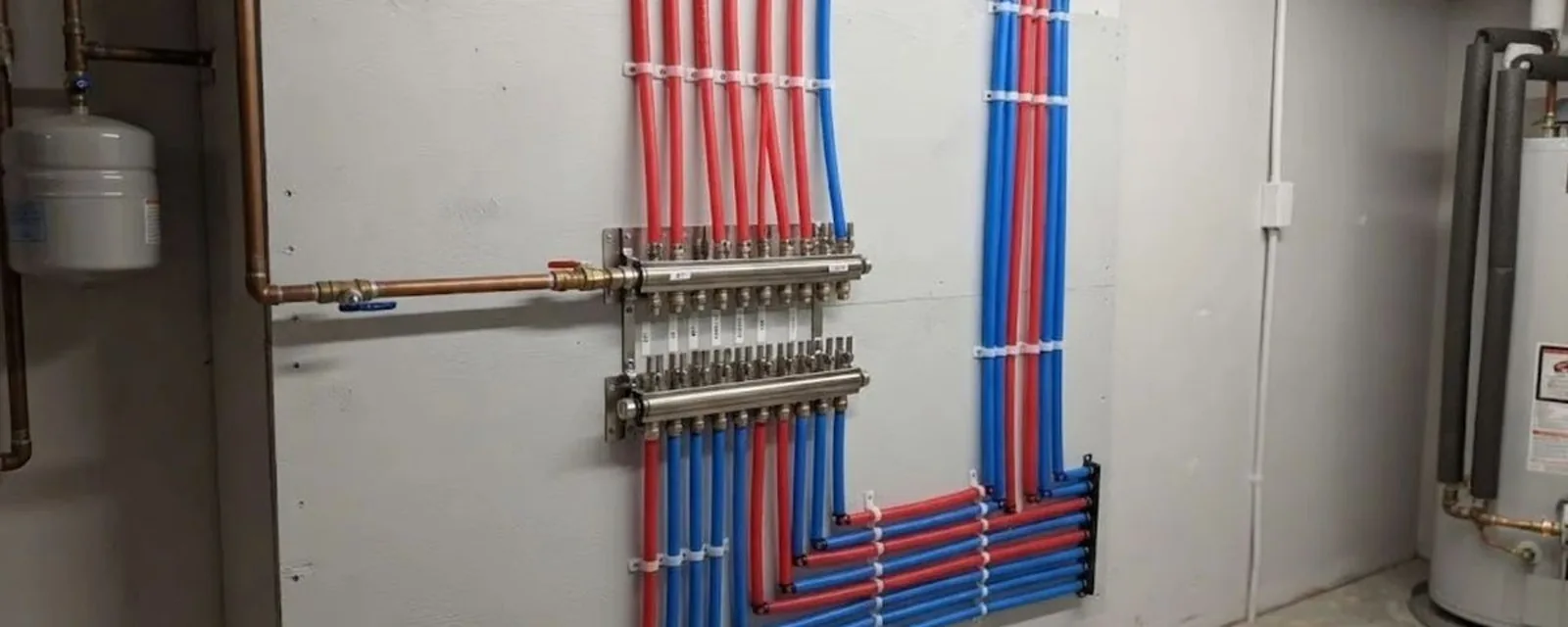
Repiping means replacing the water supply pipes that run through a house, either all of them or a failing section, with new copper or PEX. It is the answer when a house keeps springing leaks in different places, delivers rusty or weak water, or carries a pipe material known to fail. Drains and sewer lines are a separate system. If you have an active leak right now, close the main valve and call (732) 466-1098.
A repipe is a big job, so it should start with proof. We find where the leaks are, check the pipe wall, and test pressure before recommending anything. Sometimes a repair is the honest answer, and we will say so.
Signs the supply pipes are wearing out
One symptom does not mean a repipe. A pattern across the house does.
Repeated pinhole leaks
A second or third leak in a different spot suggests the whole run is thinning from the inside.
Brown or orange water
Rust flakes after a quiet night often come from galvanized steel corroding from within.
Weak flow at every fixture
Mineral scale and rust narrow old pipes until a shower cannot run while a dishwasher fills.
Green crust at fittings
Blue-green stains on copper joints show a slow weep that will not stop on its own.
Wall stains and a metered drip
A meter that turns with taps off and damp patches on walls point to concealed damage. See leak detection to confirm.
Galvanized, copper and polybutylene: what each fails from
Older supply materials die in different ways, which changes how urgent a repipe is.
| Material | Typical failure | What you notice | Verdict |
|---|---|---|---|
| Galvanized steel | Rust builds inside until the bore shrinks | Low pressure, brown water | Repipe is usually the cure. |
| Copper (thin wall) | Pinholes from pitting | Small leaks and green spots | Repipe after repeat failures. |
| Copper (sound) | Failure at joints only | An occasional drip | Repair, no repipe needed. |
| Polybutylene | Fittings and pipe degrade | Sudden leaks at connectors | Replace on a plan. |
| CPVC (aged) | Brittle cracks at fittings | Splits after temperature swings | Replace failing runs. |
Polybutylene is the gray or blue flexible plastic pipe used in some homes built from the 1970s into the mid-1990s. If you see it at the water heater or main, ask us for an assessment.
Neptune's water and what it means for copper
New Jersey American Water reports hardness of 72 to 140 ppm as calcium carbonate in its Coastal North system, and the water is treated with ortho-phosphate for corrosion control. That film helps protect pipe walls, but it cannot restore a pipe that is already thin. Your decision still comes down to the age and condition we find.
Hardness leaves scale inside old steel and at fittings, so it speeds the loss of flow in galvanized lines. If the buried line to the house is also old, water service line repair may belong in the same plan.
Pinholes keep appearing?
Have us test the system before you commit to a full repipe.
Victorian walls in Ocean Grove and similar older homes
Ocean Grove's Camp Meeting Association District is a National Register of Historic Places district, with Queen Anne, Stick and Craftsman homes from the periods 1850 to 1924. Wood-frame walls in these homes can hold decades of past work, with plaster, tight stud bays and runs that were moved over time. Access, not pipe cost, is often the hard part.
Because historic-district review may apply, check any historic-district review that applies before opening finished walls or changing visible trim. We plan chases through closets, basements and attics first. Homes of the same era in Asbury Park present similar access puzzles.
PEX or copper: the honest trade-offs
Both are accepted for supply piping under the National Standard Plumbing Code. The right pick depends on access, budget and how you feel about each material.
| Factor | PEX | Copper |
|---|---|---|
| Install in finished walls | Flexes around corners, fewer cuts | Rigid, needs more openings. |
| Joints | Crimped or expansion fittings | Soldered joints. |
| Freeze tolerance | Expands more before splitting | Splits sooner under ice. |
| Sun and outdoors | Must stay out of sunlight | Fine in exposed runs. |
| Appearance | Plastic where it shows | Classic metal look. |
| Pitting risk | None from water chemistry | Possible in aggressive water. |
Many houses end up with both, such as PEX in the walls and copper at exposed or high-heat spots.
Whole house or one section at a time?
A phased repipe replaces one floor, one bathroom group or one branch at a time. It spreads out cost and disruption, and it can follow a kitchen or bath remodel. The risk is that untouched old lines keep failing while you wait.
A full repipe is faster overall, uses one inspection plan and ends the pinhole chase. If the leak history shows several failures across floors, we usually advise doing it once. If the failure is one stub and everything else tests sound, a targeted fix is better. We will not push the bigger job.
How a repipe unfolds in an occupied house
Planning the order of rooms matters more than the pipe itself.
Survey and map
We trace each branch, mark fixtures, and decide where small access openings will go.
Protect the house
Floors, furniture and fixtures are covered before any opening is cut.
Run the new lines
New manifold or trunk lines are pulled through walls and framing, and old pipe is capped or removed.
Pressure test and inspect
The system is tested under pressure and then inspected before the walls are closed.
Restore water, then patch
Water comes back on room by room. Drywall and plaster are patched once the inspector signs off.
Walls, patching and who does the painting
Plumbers open walls and leave them patch-ready. Finish drywall, plaster, tile and paint are usually other trades. Ask about this when you compare quotes, and plan a painter or carpenter for after the inspection.
Permits and inspections for a repipe
Permit rules vary, so ask the Neptune Township construction office. The township's 2018 fee schedule lists $27 per plumbing fixture or device and a $95 minimum per subcode, and the office can confirm current fees. In Belmar, the Construction Department says unpermitted work can be fined $500 to $2,000.
For one and two family houses, the township requires rough plumbing inspection before walls are covered, finish plumbing for piping, trim and fixtures, and a final plumbing inspection. Request each at least 24 hours ahead. The township says it performs them within three business days of your requested time.
Questions to ask before you accept a repipe quote
Quotes can look alike and differ in scope. Put these questions to every bidder.
- Which pipe material, and why that one for this house?
- How many access openings, and who patches them?
- Is the permit included, and who schedules the inspections?
- Does the quote include the main shutoff and a pressure reducing valve check?
- What happens to old pipe and any insulation or wrap that is removed?
- How many days will the water be off, and what is the plan for those days?
- Is the plumber licensed? Verify it on the state's License Verification System.
What drives the cost of a full-house repipe
Two houses of the same size can have very different repipe costs. These are the biggest drivers.
Insurance rarely pays for a planned repipe, though it may cover resulting water damage from a sudden burst. Ask your insurer before work begins.
Repiping questions in Neptune, NJ
A single leak on sound pipe is a repair. Several leaks across floors, rusty water at every tap or a pipe wall that crumbles when cut points to repiping. We test pressure and examine cut sections before saying which.
Rust flakes from galvanized steel or a corroding fitting are a common cause. If the water clears after a short run, the piping is a likely source. If it stays discolored, the cause may be upstream, so ask your utility.
Not usually all of them. We plan small access openings in closets, basements and attics, and we fish PEX through framing. In plaster-and-lath houses, we try to minimize cuts and leave openings ready for patching.
Permit rules vary, so ask the Neptune Township construction office. The township's 2018 fee schedule lists $27 per fixture or device and a $95 minimum per subcode, with rough, finish and final plumbing inspections for one and two family homes. Confirm current fees with the office.
We schedule by unit or by floor, give tenants written notice of water shutoffs, and keep one fixture usable where possible. A property manager can authorize the work and receive an itemized invoice for each unit.
It depends on the size of the house and the plan. We plan the job so water can return to as many fixtures as possible at the end of each work day, and we explain the schedule when we give you the price before work starts.
It can be when the pipe material worries buyers or inspectors. Compare a partial fix, a credit at closing and a full job. A single failure is a job for burst pipe repair, while a pattern of failures favors a repipe.
Related plumbing services
Sources referenced on this page: New Jersey Department of Community Affairs, plumbing subcode (N.J.A.C. 5:23-3.15), National Standard Plumbing Code. New Jersey American Water, Coastal North annual water quality report. Neptune Township construction office, 2018 fee schedule (Ordinance 18-25). NJ Division of Consumer Affairs, License Verification System. National Park Service, National Register of Historic Places record for the Ocean Grove Camp Meeting Association District.