
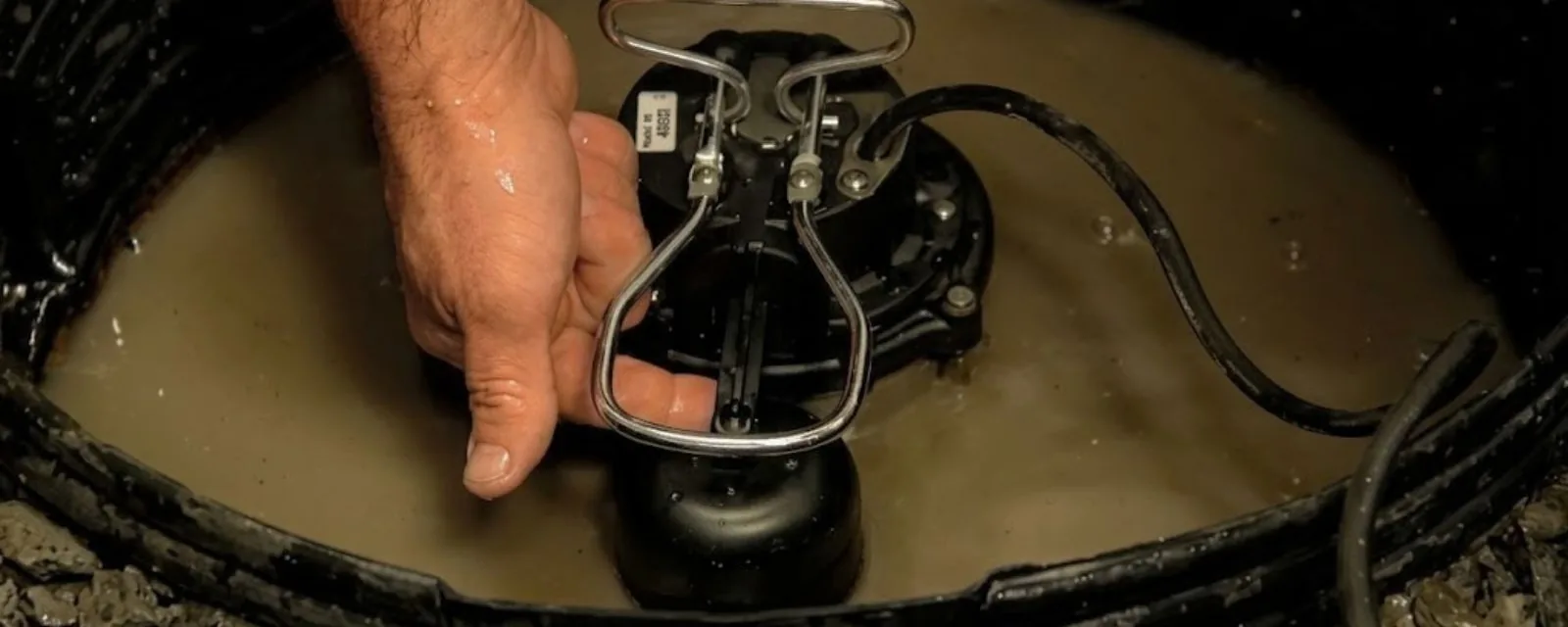
A sump pump sits in a pit in the lowest part of a basement or crawl space and pushes groundwater out through a discharge pipe before it reaches the floor. When it stops, runs without pause or cannot keep up with rain, water rises fast.
Call the 24/7 emergency line at (732) 466-1098 if the pit is overflowing. While you wait, do not touch anything standing in water, and keep out of any room where water touches outlets or the panel.
This page covers sump pump repair, replacement and installation, along with backup power and discharge. It does not cover foundation cracks or masonry repair, which belong to other trades. Where water seeps in without a pit, see basement waterproofing.
Basement filling and the pump silent or running nonstop?
First, check the power. A tripped breaker, an unplugged cord or a power outage is the most common reason a pump goes quiet. If the outlet is dry and reachable, reset the breaker. If water is already near the outlet or panel, stay out of the room and do not touch the panel while standing in water.
A pump that runs constantly may have a stuck float, a failed check valve, or more water coming in than it can move. Do not run a wet vacuum from a wet outlet. Call (732) 466-1098 and tell us what the pit looks like, whether the pump hums, and whether the discharge pipe outside is flowing.
What usually fails inside a sump system
Most pumps do not fail all at once. One part gives out, and the rest cannot cover for it.
Float switch
A float that sticks on the pit wall or tangles with the cord keeps the pump from starting, or from stopping.
Check valve
A worn valve lets pumped water fall back into the pit, so the motor cycles on and off.
Motor or impeller
Silt and grit jam the impeller, and a seized motor hums without moving water.
Discharge line
A frozen, kinked or clogged line sends water back toward the pit.
Power supply
A tripped breaker, a failed outlet or an outage stops the pump with no warning.
Why Neptune basements need a plan for water
The township's flood zone maps use AE, AO, VE and X categories, and large residential areas, including all of North Island, sit in flood zones. Land along the Shark River and near Deal Lake and the other lakes tends to hold groundwater, so a pit can fill sooner after rain. If your address is in a mapped zone, a working pump is part of keeping the house usable.
Superstorm Sandy showed the other risk. Shark River Hills, Ocean Grove and North Island were the most damaged and flood-susceptible neighborhoods, and the township was without power for fourteen days. A pump that depends only on household power is not enough in that kind of event, so backup power belongs in the plan.
Test the pump before rain
Pour in a bucket of water and watch it cycle.
Backup options when the power goes out
Pick the backup by how long outages last and how much water you move.
| Backup | Fits when | Runtime | Limit |
|---|---|---|---|
| Battery backup pump | Short outages, moderate inflow | Hours, depending on battery and load | Battery needs testing and eventual replacement. |
| Water-powered backup | Municipal water is available | As long as water pressure holds | Uses household water and needs pressure. |
| Generator circuit | Long outages, whole-house needs | As long as there is fuel | Needs a transfer setup and an electrician. |
| Second pump on its own float | High inflow or critical space | Same as main pump | Both still need power. |
| High-water alarm | Any basement | Alerts only | Warns you but does not pump. |
After a fourteen-day outage like Sandy, a battery alone will not carry a flooded basement. Think in layers: battery first, and a generator plan for long events.
Repair it or replace it?
A pump is a working part, not a permanent one. These signs help decide.
- Rust, a loud grind or a burned smell from the motor.
- Short cycling, where the pump starts and stops every few seconds.
- A pump that runs but moves little water.
- A float or switch that fails again after being cleaned.
- A pit full of silt, gravel or debris that keeps recurring.
- A pump that has needed several repairs or is far older than it should be.
A new float or check valve is a modest repair. A seized motor or a tired pump is usually better replaced, because a repaired old pump still fails in the same storm.
Installing or replacing a pump, step by step
A neat install keeps the pump from short cycling and makes later service easy.
Size the pit and pump
We check the pit depth, how fast it fills and how high the water has to be lifted.
Set the pump level
The pump sits on a firm base so the float swings freely and the intake stays clear of silt.
Add the check valve
A check valve on the discharge pipe stops water from draining back into the pit.
Route the discharge
The pipe runs outdoors to a place where water drains away from the foundation.
Test with water
We fill the pit, watch the cycle and confirm the discharge flows and shuts off cleanly.
Where the discharge water must not go
Sump water should not be routed into the sanitary sewer. Clean groundwater overloads sewer systems and treatment plants, and local rules commonly forbid it. Check local rules, and ask the Neptune Township construction office or your borough before choosing a discharge point.
Point the discharge away from the house and from the neighbor's lot, and keep it from freezing or clogging. In low areas it can help to run the line to a storm drain or dry well where allowed. If a gutter drain shares the path, consider drain cleaning on that line first.
Permits, floodplain rules and electrical work
Permit rules vary, so ask the Neptune Township construction office whether a pump swap or a new pit needs a permit. The township's 2018 fee schedule lists $27 per plumbing fixture or device and a $95 minimum per subcode, and the office confirms current fees. If you are cutting or enlarging a pit in a flood zone, the township also requires a Floodplain Development Permit before development begins.
Pump power should come from a ground-fault protected outlet on a dedicated circuit. An electrician handles panel changes and generator transfer switches, and we coordinate with them. Owners in Belmar, on the south bank of the Shark River, and in Ocean Township, near Deal Lake, should confirm these details before choosing a pump size.
Test your pump before the next storm
A two-minute test shows most problems while they are still cheap to fix.
- Pour a bucket of water into the pit and watch the pump start, run and stop.
- Confirm the discharge pipe outside flows and has no ice or leaves in it.
- Press the test button on the battery backup and check the charger light.
- Look for silt, debris or a float touching the pit wall.
- Replace the battery on the maker's schedule and mark the date.
- Move stored items off the floor near the pit.
What a sump pump job costs depends on
A float swap is small. A new pit with a battery backup is larger. These factors set the price.
Many homeowner policies exclude groundwater or sump failure unless a water backup endorsement is added. Ask your insurer what yours covers before the next storm.
Sump Pump questions in Neptune, NJ
Yes. The 24/7 emergency line at (732) 466-1098 is open around the clock, including storm nights and holidays.
While you wait, check the breaker only if the outlet is dry, move belongings off the floor and stay out of any room with water near outlets. We do not promise an arrival time, but we will tell you what to do next.
A stuck float, a failed check valve or a high water table can all do it. If water falls back into the pit after each cycle, the check valve is likely worn. A constantly high pit may also mean groundwater is rising or a pipe is leaking, so ask us to check both.
It depends on the battery, the pump and how often water flows in. A heavy storm can drain a battery in hours, which is why long outages call for a generator or a second layer of backup.
Permit rules vary, so ask the Neptune Township construction office. The township's 2018 fee schedule lists $27 per fixture or device and a $95 minimum per subcode. A Floodplain Development Permit applies before development in a flood zone.
No, plan on routing it outdoors. Groundwater in the sanitary sewer is commonly prohibited, so check local rules with the township or your borough before choosing the discharge point.
Check your lease, and tell the landlord or property manager in writing right away. The pump is normally part of the building, so the owner usually arranges service. In an emergency we can start work and give the owner an itemized invoice.
A pump removes water from the pit, but it does not seal cracks or stop water entering through a wall. Foundation repair and masonry belong to other trades, though we handle interior drainage that feeds the pit.
Related plumbing services
Sources referenced on this page: Neptune Township construction office, 2018 fee schedule (Ordinance 18-25). NJ Department of Community Affairs, Strategic Recovery Planning Report on Neptune Township (2014).