
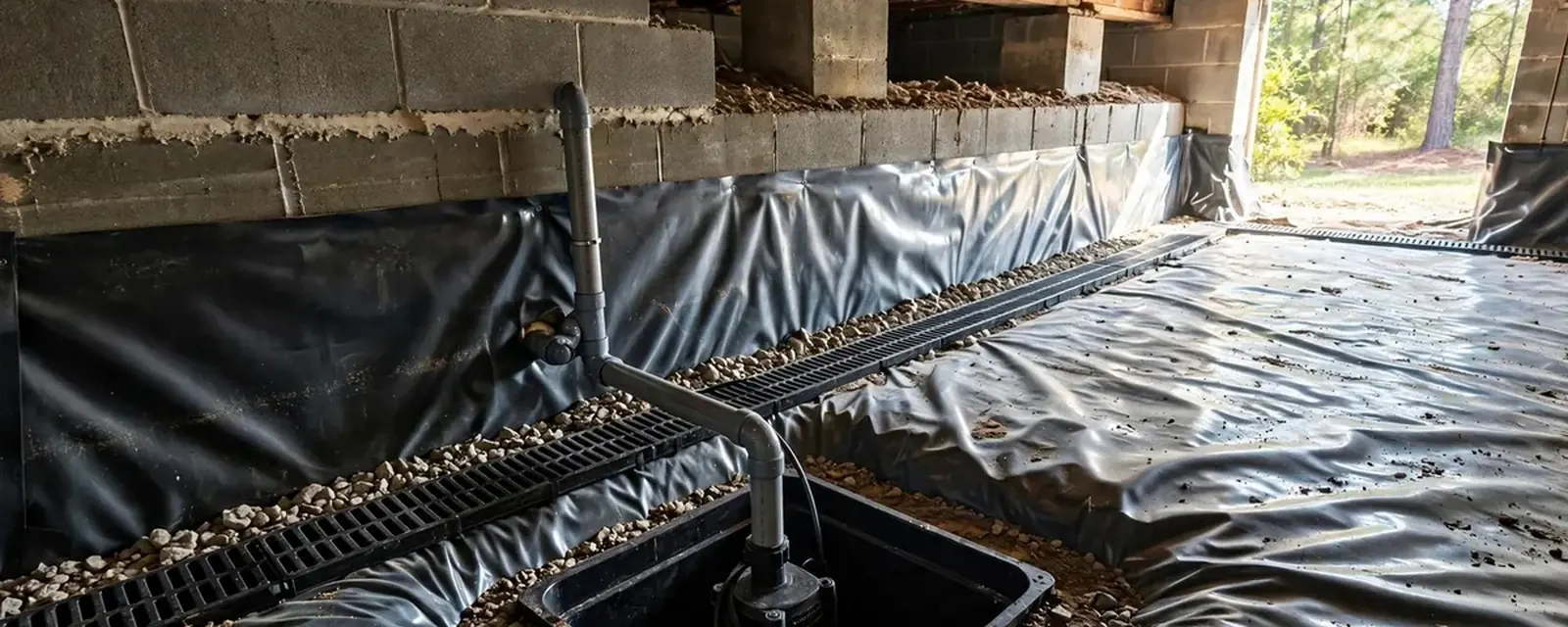
Basement waterproofing is the work of keeping groundwater and surface water out of the lowest level of a house, or of collecting it and sending it away before it reaches finished space. The cause is rarely one thing. Roof water, grading, a clogged drain line, high groundwater and a failed pipe can all end up as the same wet floor. If water is rising right now, see our sump pump service or call (732) 466-1098.
We start by finding the source, because a waterproofing job aimed at the wrong cause fails after the next storm. A plumber covers drainage, sump pits, pipes and drain connections. Some parts of the job belong to other trades, and this page says where.
Where basement water actually comes from
Identify the entry point before choosing a fix. Each source has a different cure.
Floor-wall joint
Water that seeps where the slab meets the wall is usually groundwater pushing upward, and an interior drain suits it.
Cracks in the wall
Cracks leak after heavy rain. Sealing them is masonry work, but the water behind them still needs a way out.
Window wells
Wells without drains fill with rain and spill over the sill.
Roof and downspouts
Roof water dumped next to the foundation soaks the soil and finds the nearest gap.
Plumbing sources
A leaking supply pipe, a failing drain or a water heater tank can mimic a wall leak.
Who handles what
Waterproofing spans several trades. Knowing who does what keeps you from paying twice.
| Problem | Plumber | Other trade |
|---|---|---|
| Sump pit and pump | Installs, repairs, sets discharge | Electrician for new circuits. |
| Interior drain along the wall | Cuts the floor, lays pipe, connects to the pit | Mason for the concrete patch. |
| Clogged underground downspout line | Jets and cameras the line | Yard contractor for restoring the surface. |
| Foundation cracks and wall repair | Not our work | Foundation or masonry contractor. |
| Exterior excavation and membrane | Connects drain tile to the pit or storm line | Excavation and waterproofing contractor. |
| Grading and gutters | Checks drain connections | Grading contractor and gutter installer. |
We will tell you if your problem is on the other side of this line. A report that names the cause is worth having whichever trade you hire.
Hydrostatic pressure, in plain words
When the soil around a foundation stays saturated, the water presses on the walls and slab with real force. It will push through cracks, joints and porous concrete over time. That pressure, not the rain itself, is why a basement can stay damp for days after a storm has passed.
Relieving that pressure is the point of interior drains and sump systems. A drain along the footing collects water and sends it to a pit, from which a pump discharges it outdoors. A damp basement with no pit and no drain is a basement with nowhere for that pressure to go.
Water after every storm?
Let us check the drains, pit and downspout lines first.
Fix the outside water first
Many basements dry out after these simple checks, and they cost far less than interior digging.
- Clean gutters and make sure each downspout empties several feet from the foundation.
- Check that underground downspout lines flow. Pour a bucket of water in the pop-up emitter and watch the outlet.
- Walk the yard and note spots where soil slopes toward the house.
- Clear leaves from window well drains and covers.
- Look for sunken areas along the wall that hold water.
- Run the hose beside the foundation for a few minutes and check inside for seepage.
A clogged underground gutter line is a plumbing job. We camera and jet it, which is covered in drain cleaning and hydro jetting.
Interior drain, sump or exterior membrane
These approaches solve different problems. They are often combined.
| Approach | How it works | Disruption | Best when |
|---|---|---|---|
| Interior perimeter drain | Pipe under the floor edge directs water to a pit | Break and patch a strip of floor | Water enters at the floor-wall joint. |
| Sump pit and pump | Collects water and pumps it outdoors | One pit in the floor | A high water table or recurring seepage. |
| Exterior membrane and drain tile | Seals the wall and carries water away | Heavy excavation | Wall leaks and access is open. |
| Window well drains | Connect wells to a drain line | Small dig at each well | Wells fill during storms. |
| Gutter and downspout drains | Moves roof water far from the house | Light trenching | Roof water soaks the foundation. |
Exterior work cleans the problem at its source, but it takes digging and costs more. Interior systems accept the water and manage it.
Flood zones, Sandy and the township's rules
Neptune's flood maps use AE, AO, VE and X categories, and large residential areas, including all of North Island, sit in flood zones. After Superstorm Sandy, the state recovery report identified Shark River Hills, Ocean Grove and North Island as the most damaged and flood-susceptible neighborhoods. Three township pump stations were damaged and later made watertight.
If your address is mapped, check zone and rules before digging. The township requires a Floodplain Development Permit before construction or development begins. Permit rules vary, so ask the Neptune Township construction office. Interior drains in a flood zone also need a plan for what happens when surge outruns any pump.
When the water is from the sewer, not the ground
Water that rises at a floor drain and smells foul is not groundwater. It is a sewer or drain backup, and drying the walls will not fix it. Clean-looking seepage along walls after rain is groundwater. Telling them apart changes the repair.
Sewer backups are covered under sewer line cleaning. After Sandy, damaged pump stations risked raw sewage backing up into flooded streets, a reminder that flood zones can stress both systems at once.
What a diagnosis visit looks like
We aim to leave you with a clear answer, not just a quote.
Walk the outside
Gutters, downspouts, grading and window wells are checked before we go inside.
Inspect the basement
We look at wall stains, efflorescence, the floor-wall joint and any existing pit.
Measure moisture
A moisture meter shows how far dampness extends into walls and slab.
Rule out plumbing
A meter test and visual check eliminate a leaking pipe. See leak detection if one is suspected.
Explain options
You receive a plain-language summary and a clear price before work starts for the plumbing portion.
What waterproofing cannot do
No system is magic. A sump pump without power does nothing, a drain line that clogs overflows, and a house in a surge zone can flood regardless of the pit. We will not promise a perfectly dry basement. We will explain which risks the work reduces and which it cannot.
What drives the cost of waterproofing
Waterproofing prices vary widely because the scope varies. Exterior work from the outside costs more than interior drainage, and these factors explain why.
Many home policies exclude groundwater seepage, and flood insurance is a separate product. Ask what yours covers before choosing a scope.
Basement Waterproofing questions in Neptune, NJ
Humidity, a slow plumbing leak and saturated soil can all do it. A moisture meter and a meter test help sort them out, and a dehumidifier handles condensation but not leaks.
We handle the plumbing side, including drain tile connections, sump systems and storm drain tie-ins. Excavation, membranes and foundation repair may involve other trades, and we say so plainly.
Wall length, depth, soil, access and restoration decide it. Digging around a foundation costs more than interior drainage. Call (732) 466-1098 and we will explain the plumbing portion with a clear price before work starts.
Permit rules vary, so ask the Neptune Township construction office. The township's 2018 fee schedule lists $27 per fixture or device and a $95 minimum per subcode. In a flood zone, a Floodplain Development Permit applies before development begins.
Report it in writing to the landlord or property manager, move belongings up and photograph damage. Structural water entry is generally the owner's problem, though the lease governs. We can document the cause on an itemized invoice.
Yes. We run a camera to find the clog, then jet or cable the line. If the line is crushed or has collapsed, we explain the repair options.
Not always. A pump needs a pit, a drain path to the pit, a working discharge and backup power. Often the right setup is a pit fed by an interior drain, a common question for homes near Bradley Beach and Neptune City where lakes and the Shark River sit close by.
Related plumbing services
Sources referenced on this page: Neptune Township construction office, 2018 fee schedule (Ordinance 18-25). NJ Department of Community Affairs, Strategic Recovery Planning Report on Neptune Township (2014).