
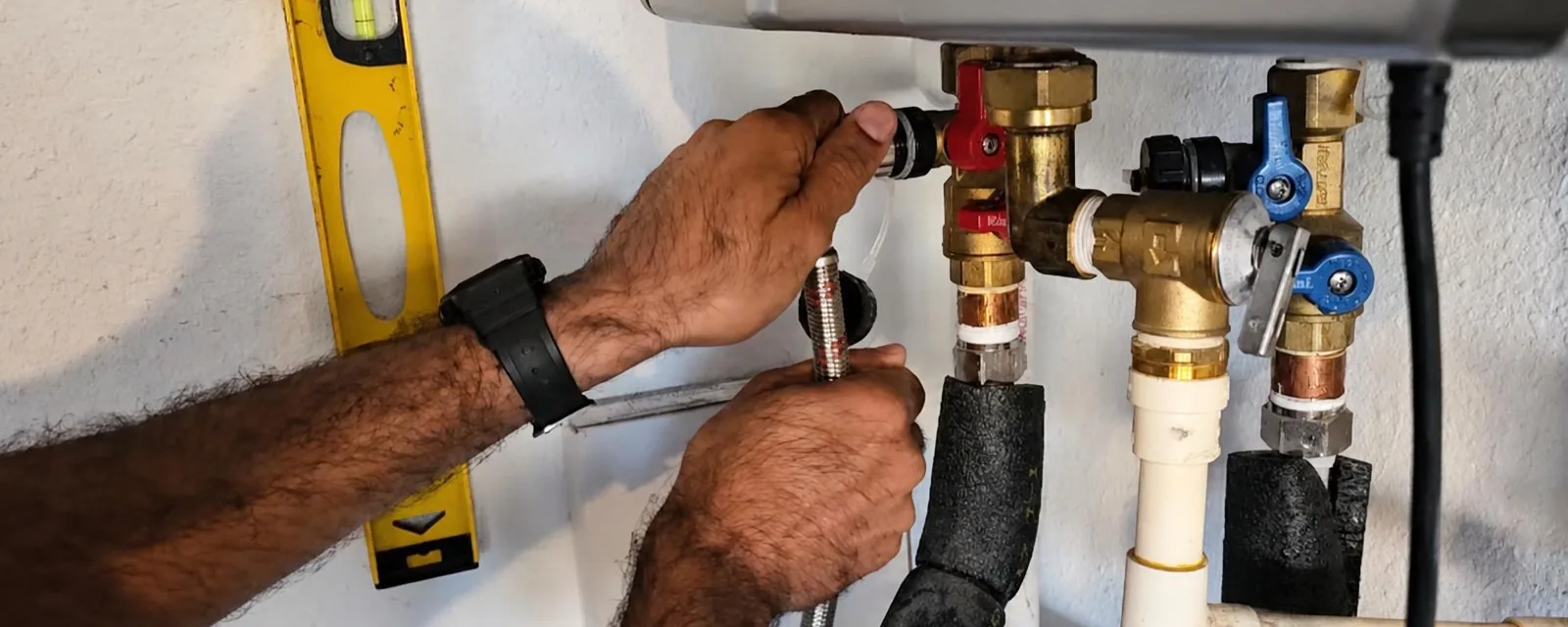
A tankless water heater commonly lasts about 20 years, roughly twice the life of a typical tank. That figure assumes regular maintenance. In moderately hard to hard water, the thing that cuts a tankless life short is scale inside the heat exchanger, and it builds quietly.
Scale does not announce itself until hot water turns lukewarm, the unit throws an error code, or the flow drops. A flush once a year, using isolation valves and a descaling solution, is the single habit that protects the investment. This guide covers what shortens a lifespan, how to flush, and which signs mean it is time to call.
What shortens or extends a tankless lifespan
Several factors work together. This table sorts them by effect.
| Factor | Effect on lifespan | What you can do |
|---|---|---|
| Scale from hard water | Largest threat, narrows the heat exchanger | Flush yearly, consider a scale-reduction filter. |
| Gas supply and venting | Poor combustion stresses the unit | Have the vent and gas pressure checked. |
| Inlet water filter screen | A clogged screen starves flow | Clean it during each flush. |
| Heavy daily use | More cycles, faster wear | Size the unit for the household. |
| Long periods vacant | Freeze risk and stagnant water | Drain and shut down for the off-season. |
| Skipped maintenance | Warranty and efficiency both suffer | Keep a service date on the unit. |
Why hard water hits a tankless harder than a tank
A tank heater has a large body of water and a wide burner or element, so scale settles on the bottom and in some cases goes unnoticed for years. A tankless unit pushes water through narrow passages heated to high temperatures. That is exactly where dissolved calcium comes out and sticks.
As the passages narrow, the unit works harder and the water temperature becomes unstable. Over time the exchanger can overheat and fail. Flushing dissolves the buildup before it hardens, so the schedule matters more than the brand.
Tank life versus tankless life
A storage tank holds hot water in a steel shell with a sacrificial anode rod. Once the rod is used up, the steel starts to corrode, which is why many tanks last only eight to twelve years. A tankless unit has no tank to rust, so its limits are the heat exchanger, the burner or elements and the electronics.
Parts on a tankless unit can be replaced, which is how some reach 20 years. That is also why a tankless is worth maintaining while a worn tank often is not.
How a yearly descaling flush works
Units with service valves installed make this a one-hour job. If yours has none, a plumber can add them.
Turn off power and gas
Shut the gas valve and unplug the unit or switch off its breaker.
Close the isolation valves
These sit on the hot and cold lines under the unit. Open the purge ports to release pressure.
Connect the pump and hoses
A small submersible pump circulates a descaling solution from a bucket through the heat exchanger.
Circulate for the recommended time
Follow the manufacturer's guide. Heavy scale may need a longer run.
Rinse with clean water
Flush the solution out fully, clean the inlet screen, and reopen the valves.
Restore power and test
Run a hot tap and confirm steady temperature and no error codes.
Signs your tankless unit needs attention
Catch these early and a service call is much smaller than a replacement.
Water turns lukewarm
A scaled exchanger can no longer transfer heat evenly.
Cold water sandwich
A burst of hot, then cold, then hot again, often from flow or sensor trouble.
Error codes
Many units flag exhaust, ignition or flow faults. Write down the code before you reset.
Rumbling or popping
Often scale boiling in the exchanger. Flushing may clear it.
Low flow at every tap
A blocked inlet screen or a clogged exchanger.
Gas pressure, venting and electrical needs
A tankless gas unit draws far more gas at once than a tank burner. If the gas line is too small, the unit starves at full demand and runs hot and short-cycles. That stress wears parts faster, so confirm line size and gas pressure before any install, and again if performance drops.
Condensing models vent through plastic pipe and drain acidic condensate, which needs a neutralizer and a proper drain. Check that the condensate line is not blocked and that the neutralizer cartridge is fresh. Even gas models need a small electrical supply for the fan and controls, so a power outage means no hot water.
If you ever smell gas
A gas smell near a tankless unit means leave the building and call the gas utility or 911 before you call a plumber. Do not flip switches or use a phone inside. If water is pooling around the unit or the control board, stay away from the wet area and do not touch any electrical panel while standing in water.
When replacement makes more sense than repair
Past about 15 to 20 years, parts may be hard to find, and a failed heat exchanger is often the most expensive part. At that stage replacement is usually wiser than another repair. If the unit is younger, a service call and a flush can bring it back.
If you are weighing a switch from a tank to tankless, tankless water heater service in Neptune explains what the unit needs. A new setup also involves venting, gas line capacity and electrical supply, which the water heater installation team can assess on site.
What Neptune homeowners should know
New Jersey American Water reports hardness of 72 to 140 ppm as calcium carbonate in its Coastal North system, about 4 to 8 grains per gallon. Your street may sit anywhere in that range. At the upper end, scale builds faster, so a yearly flush is a minimum, and you may want a water test and a scale-reduction filter before installation.
Neptune City and Bradley Beach are both in the report's list of communities served. Bradley Beach has 33.0 percent of its 3,221 housing units vacant, which points to many seasonal and second homes. If your place sits empty over winter, drain the unit and lines or use the freeze protection steps in the manual, since a tankless can crack if the water inside freezes.
The state plumbing subcode defines hot water as 120 to 140 degrees F, so set the unit inside that range. Before a new install in Neptune City or Bradley Beach, ask the local construction office about permits. Rules vary.
Source type: NJ American Water Coastal North 2025 water quality report and 2020 Census housing counts and NJ plumbing subcode (NSPC)
Questions about this topic
Once a year is the common baseline. With water in the harder end of the local 72 to 140 ppm range, or if you see temperature swings, a plumber may suggest flushing more often.
If service valves are installed and you are comfortable with hoses and a small pump, yes. Gas appliances need care with shutoffs and venting, so if you are unsure, book a service visit.
Softening or scale-reduction treatment can lower the buildup rate. Ask a plumber what suits your hardness and household before buying equipment, since some units have specific water requirements.
Close the main water valve, drain the unit and the lines using the manufacturer's steps, and turn off gas and power. A tankless left full in an unheated space can freeze and crack its heat exchanger.
Repeated error codes, falling output after flushing, leaks inside the cabinet, and age past about 15 years are all signs. A plumber can inspect the heat exchanger and give a clear price before work starts.