
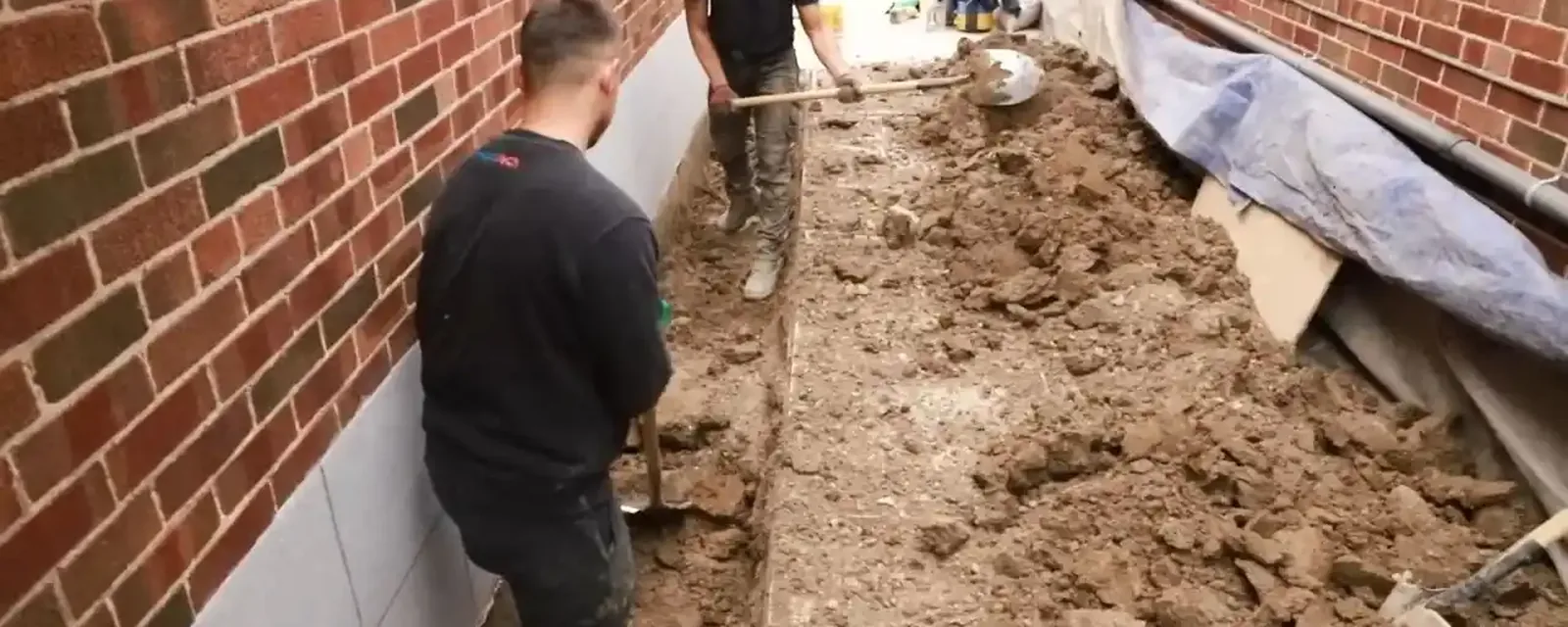
Exterior basement waterproofing means excavating down to the foundation footing, cleaning the wall, sealing it with a membrane, adding a drainage board and a perimeter drain, and backfilling with free-draining stone. The goal is to stop water before it reaches the wall. It is the most thorough way to treat a leaking foundation, and it is also the most disruptive and the most expensive.
Because of that, it is not the first answer for every wet basement. This guide explains the process, the cost drivers, how it compares with an interior drain system and a sump pump, and which problems it does not solve.
What happens during an exterior dig
The sequence is the same on most houses, though access and soil change the details.
Locate utilities and set limits
Gas, water, electric and sewer lines are marked before any digging. Some walls cannot be reached without moving a deck, steps or landscaping.
Excavate to the footing
Soil is removed along the wall down to the footing, usually by machine, then hand-dug near the foundation.
Clean and repair the wall
The wall is washed, cracks are patched and any tie-rod holes are sealed. A crack that is moving needs a structural opinion first.
Apply the membrane
A waterproof coating or sheet goes on the wall, then a dimpled drainage board to let water fall to the footing.
Install the perimeter drain
Perforated pipe in washed stone runs beside the footing, sloped to a daylight outlet or to a sump pit.
Backfill and regrade
Stone and soil go back in layers. The final grade should slope away from the house.
Exterior waterproofing vs interior drain vs sump only
Each approach handles a different part of the water problem.
| Approach | What it stops | Disruption | Main limit |
|---|---|---|---|
| Exterior membrane and drain | Water at the wall, before it enters | Yard dug up for the full run | Needs access on all wet sides. |
| Interior perimeter drain | Water that reaches the slab edge | Concrete cut inside the basement | Wall stays wet, so humidity remains. |
| Sump pump alone | Rising groundwater under the slab | Small pit in the floor | Does not treat wall seepage. |
| Crack injection | One leaking crack | One wall, one day | Does not stop other cracks or hydrostatic pressure. |
| Grading and gutter fix | Surface water near the wall | Light yard work | Does not help with groundwater. |
Many basements need a combination of two or more of these. A sump pit often ties into either a perimeter drain or a gutter drain line.
What drives the cost of an exterior job
No honest price can be given without a site visit, but these factors set it.
Length and depth of wall
Linear feet and wall depth set how much soil comes out and how much membrane goes on.
Access
Narrow side yards, fences, decks and trees slow excavation and often mean hand digging.
Soil and groundwater
Wet or sandy soil needs shoring and pumping while the trench is open.
Wall condition
Block walls with deep cracks or bowed sections need repair before sealing.
Drain outlet
A daylight outlet is simpler. A sump pit or storm connection adds work and may need approval.
Restoration
Replacing patios, plantings and steps after backfill can add as much as the waterproofing.
How long a membrane holds up
A sheet or spray membrane is only as good as its seams, its termination at the top of the wall and the stone around the drain. Silt that clogs the stone shortens the life of the whole system, so washed stone wrapped in filter fabric matters more than the brand of coating. Ask for the layers in writing.
Roots, settled backfill and downspouts that discharge near the wall can all undo the work. Keep downspouts extended well away from the foundation, and watch the grade for new dips after the first heavy rain.
When it is not a plumbing problem
Foundation cracks that are widening, walls that bow inward or floors that heave are structural issues, not drainage issues. A plumber can stop water, but a structural engineer should look at movement. Waterproofing a wall that is still shifting just seals a problem in place.
How to tell where the water is coming from
Before you pay for a dig, find the source. Tape a square of plastic to the wall and check it after a few days. Moisture on the wall side points to seepage through the foundation, and moisture on the room side points to humidity. Water along the floor-wall joint after rain points to groundwater pressure.
Also check for gutters that dump next to the foundation, downspouts without extensions and soil that slopes toward the house. Fixing these costs far less than excavation, and our basement waterproofing visits start with these checks. Where the water is rising through the slab, a sump pump often handles it from the inside.
When the inside route is the better call
Exterior work only makes sense when you can reach the wall. A house with a neighbor's fence three feet away, an attached garage on one side or a finished deck over the dig line may not allow it. In those cases, an interior perimeter drain and a sump pit manage the water that reaches the slab edge, and the cost of rebuilding a yard is avoided.
The trade-off is that the wall stays wet. Interior systems control water on the floor but leave humidity and efflorescence, the white mineral crust on block, in place. If you store paper, fabric or electronics below grade, ask how the contractor plans to deal with moisture in the air as well as water on the floor.
Questions to ask any contractor
Ask these before you sign for exterior work.
- What caused the leak, and how did you confirm it?
- Which walls will be dug, and what happens to my deck, steps or plants?
- What membrane and drainage board do you use, and how is it terminated at the top?
- Where does the perimeter drain discharge?
- Is a permit needed, and who files it?
- What does the warranty cover, and is it transferable?
What Neptune homeowners should know
Large parts of Neptune's residential areas, including all of North Island, are in flood zones marked AE, AO, VE or X on the township maps. In those zones, a waterproofing dig may count as development, and the township requires a Floodplain Development Permit before development begins. Ask the Neptune Township construction office before any excavation, since permit rules vary.
After Superstorm Sandy in 2012, the state recovery report named Shark River Hills, Ocean Grove and North Island as the most flood-susceptible neighborhoods. For homes in those areas, a perimeter drain helps with groundwater but cannot hold back a coastal surge. Treat waterproofing as one layer, along with raised utilities and a backup power plan.
Bradley Beach has a vacancy rate near 33 percent, which points to many seasonal homes, so check for moisture before you reopen a closed-up basement. Our plumbing help in Bradley Beach page covers that borough. Belmar sits on the south bank of the Shark River and has a 'What's my Flood Zone?' lookup on its website, which is worth using before you plan work. See plumbing service in Belmar for coverage.
Source type: NJ DCA Strategic Recovery Planning Report (2014), Neptune Township floodplain permit requirement and 2020 Census housing counts
Questions about this topic
It is more thorough because it treats the wall itself, but it is also more disruptive and expensive. Interior systems are quicker and cheaper but leave the wall wet. The right choice depends on access and the cause.
Yes, if the leak is limited to that wall and the grade and gutters are sound. Ask the contractor to explain why the other walls are dry.
That depends on wall length, access and weather. A contractor should give you a schedule after seeing the site, and rain can stop work for days.
Permit rules vary, so ask the Neptune Township construction office. The township requires a Floodplain Development Permit before construction or development begins, and your zone on the township map may matter.
No. It manages groundwater and wall seepage. Surge flooding comes over the surface and needs flood-proofing measures, not just a drain system.