
If a downspout overflows while the gutter above it is clean, the buried pipe below is the likely culprit. Roof runoff enters an underground drain, carries leaves, shingle grit and mud with it, and slows until the water backs up the downspout. Clearing it means finding the outlet, flushing from the top and, when that fails, running a drain machine or a water jet through the line.
This guide covers how those lines are laid out, how to tell a clog from a collapse, and what a homeowner can safely try. It also explains where the pipe ends, because that decides who is responsible and what tools can be used.
Where the water goes after the downspout
A buried gutter drain is usually a plastic pipe, often corrugated or smooth PVC, that takes water from the base of one or more downspouts. It slopes away from the house and ends in one of a few places. The common endings are a pop-up emitter in the lawn, a daylight outlet on a slope, a dry well or a tie-in to a storm drain.
The ending matters, because it tells you where to look for the blockage and how to flush it. A pop-up emitter that never opens points to a clog near the lawn end. A downspout that fills first points to a clog or a crushed pipe near the house.
Four common drain endings compared
Each ending clogs in a different way, and each needs a different fix.
| Ending | How it clogs | Easy check | Usual fix |
|---|---|---|---|
| Pop-up emitter | Mud and roots at the lid or elbow | Does the lid lift when you pour water in? | Clean the emitter, then flush the line. |
| Daylight outlet | Animals, debris, silt at the mouth | Is the opening visible on the slope? | Clear the mouth, then run a drain machine. |
| Dry well | Silt fills the stone or chamber | Does the pit stay full after rain stops? | Flush or pump out, then re-test. |
| Storm drain tie-in | Debris builds at the joint | Does the water back up quickly? | Jet the line, then ask who owns the tie-in. |
| Unknown or lost | Collapse, crushing, tree roots | No outlet found after a walk of the yard | Camera inspection to locate the pipe. |
If you cannot find the outlet, do not guess. Dig only after the line has been located, since lawn irrigation and other buried lines share the same ground.
Try these steps before you call
You can often tell clog from collapse with a hose and some patience.
Clean the gutter first
Scoop debris from the gutter and the downspout elbow. A plugged elbow looks just like a plugged drain.
Disconnect the downspout
Pull the downspout off the buried adapter, and look into the pipe. Roof grit, tennis balls and mud are common finds.
Run a garden hose
Feed a hose into the pipe and run it for several minutes. Watch the outlet for flow, and note if the water rises back up the adapter.
Probe gently
A plumber's drain auger will clear soft plugs. Stop if the cable meets a hard stop, since that often means a crushed or offset pipe, not a clog.
Record what you saw
Note which downspout fills first and how long water took to rise. This helps a plumber decide between jetting and a camera inspection.
Clog, collapse or the wrong pipe?
The same overflow can have four different causes.
Soft clog
Leaves, grit and sediment. Flushes clear with a hose and returns slowly if the gutter is not cleaned.
Root intrusion
Fine roots enter at joints and catch debris. Cable cutters or a jet nozzle clear them, and the roots return if the joint stays open.
Crushed or offset pipe
A heavy vehicle or settled soil pinched the pipe. The drain machine stops at the same spot every time, and the pipe needs a repair, not another cleaning.
Full dry well
Water drains, then stops, and returns after hours. The pit may be full of silt.
Wrong tie-in
A downspout drain feeding the house sewer is a problem. Ask the construction office before changing any connection.
How a plumber clears and checks a buried line
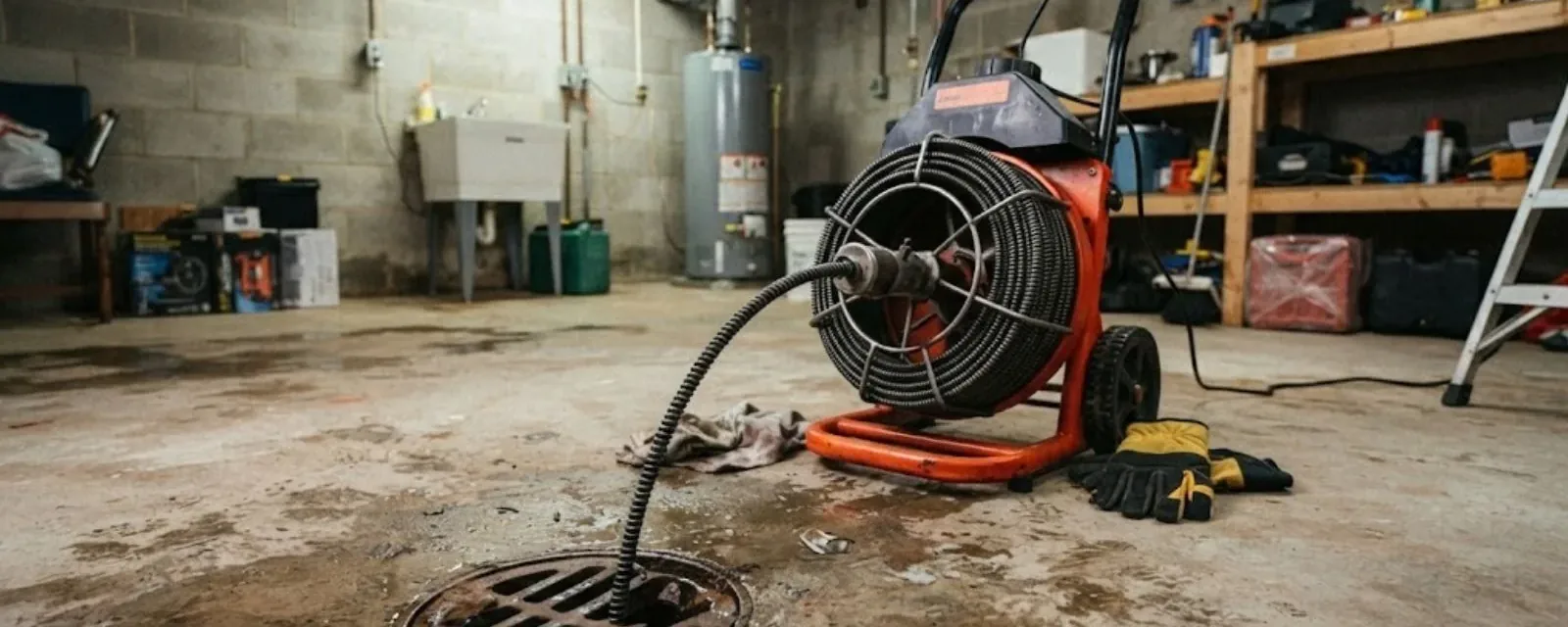
A drain machine with a spinning cable handles most soft clogs and light roots. For heavier silt, a hydro jet nozzle sends high-pressure water down the pipe, which scours the walls and flushes debris out at the end. Both methods work best when there is a place for the water and debris to leave, such as an open outlet or a cleanout.
If the line keeps clogging, a camera inspection shows whether the cause is silt, roots or a broken section. Our drain cleaning in Neptune work covers the cleaning, and a camera pass gives you a record you can show a lawn contractor or an excavator.
Do not send roof water to the sanitary sewer
Never connect or reroute a downspout into a sewer cleanout or a house drain. Roof water in the sanitary system can overload a municipal line, and the rules on this vary by town. Ask the Neptune Township construction office or your borough before any tie-in changes.
Signs the problem is bigger than the gutter drain
Roof water is sometimes the visible part of a wider drainage issue.
- Water enters the basement along one wall after every storm.
- The yard stays soft for days near a downspout outlet.
- Mulch or soil is washing out at a pipe joint.
- A sinkhole or dip appears over the buried line.
- The foundation shows damp patches at the same spot as the downspout.
Water at the foundation can also come from grading, window wells or foundation cracks, and those are not plumbing problems. Where the line discharge sits close to the house, a basement waterproofing assessment can sort out which source is responsible.
What Neptune homeowners should know
After Superstorm Sandy in 2012, the state recovery report noted that Wesley Lake and Fletcher Lake had silted in and needed de-silting and storm drain cleaning. The lesson for a homeowner is that outlets close to a lake edge can back up when the receiving water is high or full of silt.
If your downspout drain ends near Wesley Lake, the lake level may be the reason it drains slowly. See our plumbing service in Asbury Park for the lakeside side of town.
Fletcher Lake is co-managed by Bradley Beach and Neptune Township through a commission, so a drain that discharges toward it may involve more than one office. Before you change an outlet, ask the borough first. Our plumbing help in Bradley Beach page covers the borough service area.
Large parts of Neptune's residential areas, including all of North Island, sit in flood zones. In those areas, a buried drain that is clear still may not keep up with a surge. The township requires a Floodplain Development Permit before construction or development begins, so ask the construction office before regrading or adding drains.
Source type: NJ DCA Strategic Recovery Planning Report (2014) and Neptune Township floodplain permit requirement
Questions about this topic
Look for a pop-up emitter, a round lid in the lawn or a pipe mouth on a slope. If none shows, run a hose into the downspout adapter and watch where water emerges. A plumber can also trace the line with a camera and locator.
A garden hose is safe. A pressure washer nozzle can drive debris deeper, and a hard stop may mean a broken pipe. Use a drain machine or ask a plumber for a jet pass.
Only if the roof water was the cause. Check grading, window wells and cracks as well, and note that foundation cracks are structural work, not plumbing.
The pipe may be partly blocked, so it carries a trickle but not a storm. A receiving lake or storm drain that is already full can also slow the exit.
Permit rules vary, so ask the Neptune Township construction office. If the work is in a flood zone, ask about the Floodplain Development Permit as well.