
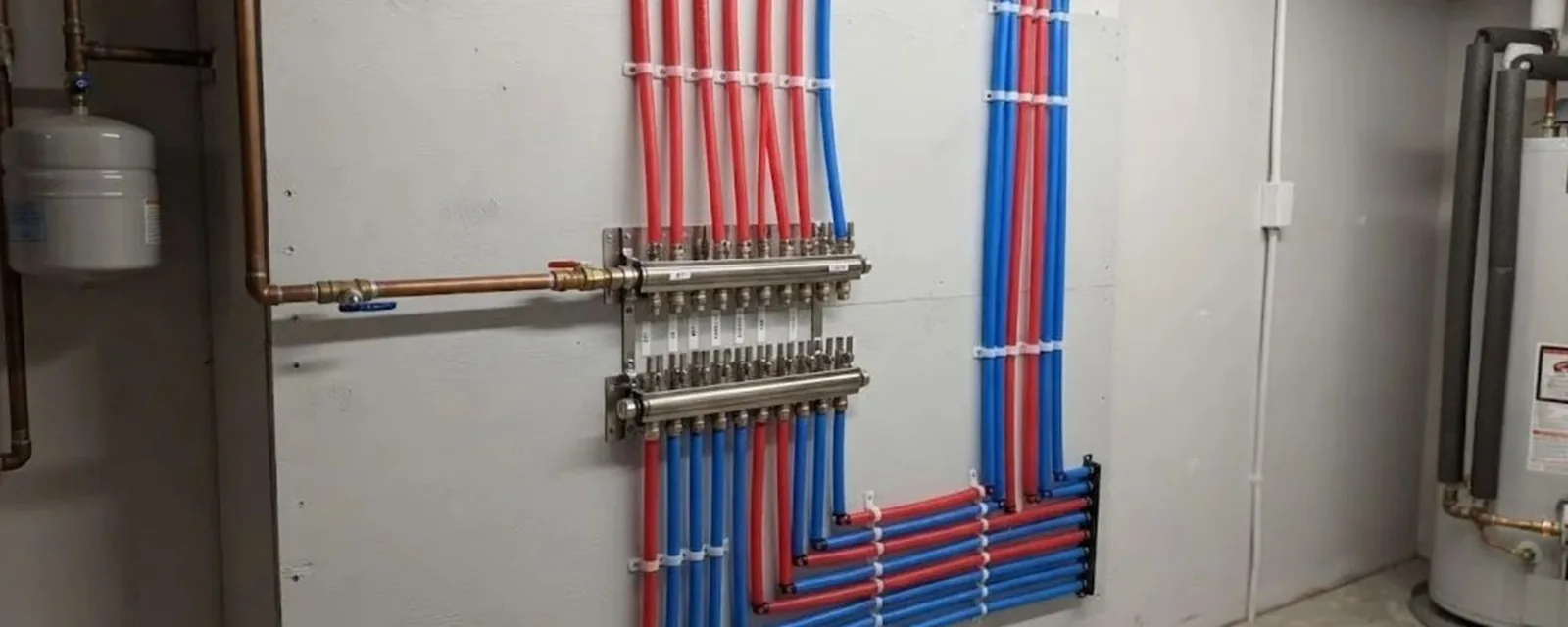
A whole-house repipe replaces the supply lines that feed every fixture, usually with PEX or copper. Cost depends on the pipe material, the number of fixtures and floors, how easily plumbers can reach the old lines, how much drywall must be opened and closed, and the permit and inspection steps. We do not list dollar figures, because two houses of the same size can differ by a wide margin.
Before you compare bids, find out whether you need a full repipe at all. A single leak, a few corroded sections or a failing service line may be fixed far more cheaply. This guide explains the signs, the options and the questions that make quotes comparable.
Signs a repipe may be on the table
Any one of these alone may not justify a repipe, but several together often do.
- Repeated pinhole leaks in different parts of the house.
- Brown or rusty water that returns after the lines are flushed.
- Low pressure at several fixtures while the street supply is normal.
- Visible green corrosion or flaking on exposed pipe.
- Galvanized steel pipe, which corrodes from the inside.
- Polybutylene pipe, a gray plastic known for failures.
One leak is a repair. A pattern across the house is the point at which repiping becomes worth pricing.
Repipe materials compared
Each material has trade-offs in install effort, durability and risk.
| Material | Install effort | Strengths | Watch for |
|---|---|---|---|
| PEX | Fastest, flexible in walls | Fewer fittings, resists freezing splits | Not for UV exposure or some hot spots. |
| Copper | Slower, needs soldering | Long record, durable | Pinhole leaks with aggressive water. |
| CPVC | Moderate | Lower material cost | Brittle with age and heat. |
| Galvanized (existing) | Being replaced | None left to count on | Rust, low flow. |
| Mixed repairs | Spot work | Cheaper short term | Mismatched metals and joints. |
Ask which pipe the plumber would use in your house and why. A good answer refers to your layout, not a preference.
What moves the price of a repipe
These are the real drivers behind any bid.
Size and fixture count
More bathrooms, floors and fixtures mean more pipe, more connections and more time.
Access
Open basements and crawl spaces are easy. Finished walls and slabs raise the labor.
Wall and ceiling repair
Opening walls is part of most repipes. Patching and paint may or may not be in the bid.
Material
PEX tends to be quicker to install than copper. Copper adds soldering and more time.
Permits and inspections
Rough and final inspections add steps. The cost and schedule depend on the local office.
Occupancy
Living in the house during the work needs staging and temporary water, which affects schedule.
How a repipe job is staged
A typical repipe takes a few days, though a large house takes longer.
Survey and plan
The plumber maps every fixture, the main shutoff and the path of new lines.
Water shut off and drain down
The system is shut off and drained. You will have water for part of each day, depending on staging.
Open access points
Small holes are cut in walls or ceilings. Lines run through existing paths where possible.
Run and connect new pipe
New lines connect to each fixture, then to the main manifold or branch layout.
Pressure test
The system is pressurized and held, while the inspector or plumber looks for any drop.
Inspection and patching
After inspection, wall openings are closed. Confirm in advance who handles drywall and paint.
The service line is a separate pipe
The service line runs from the water main in the street to your house. A repipe replaces the lines inside, and it does not replace the service line. If the incoming line is old, ask about it as a separate scope, since a new interior with an old service line can leave a weak link. Our water service line repair page covers the outside pipe.
Planning for the disruption
Plan on moving furniture away from the walls that will be opened, and clear the areas around the main shutoff and the water heater. Ask for a day-by-day plan that says when water will be off, so you can arrange laundry, cooking and showers around it.
Ask the plumber to photograph each wall before closing it. Those photos show where new lines run, which helps the next time someone drills or hangs something heavy. Keep them with your house records, along with the inspection sign-off.
Repair or repipe: a fair way to decide
If a leak is isolated, a spot repair costs a fraction of a full repipe. Ask the plumber to open the area, show the failed pipe and describe the condition of the lines nearby. If the pipe elsewhere looks clean and sound, repair is reasonable. If the pipe is thin or pitted, the next leak is likely soon.
A partial repipe, such as one floor or the lines behind one wall, is sometimes a middle path. It limits cost and disruption while removing the worst pipe. Our repiping visits start with a look at the exposed lines and the water pressure at the main.
What Neptune homeowners should know
New Jersey American Water's Coastal North report lists hardness between 72 and 140 ppm and says the system uses ortho-phosphate corrosion control. The report notes that corrosion of pipes, fittings and fixtures can add lead and copper to water.
In 2025 monitoring, the lead 90th percentile was 2 ppb against a 15 ppb action level, with 2 of 104 homes above it. Those numbers describe the system, not your house, so a test of your own tap is the way to know.
New Jersey's lead service line law, P.L.2021, c.183, requires community water systems to replace all lead service lines within 10 years, the whole line from main to building. That covers the outside pipe only. A repipe covers the inside, so ask both questions when you plan: what is the service line made of, and what is the pipe inside?
Neptune Township's 2018 fee schedule lists $27 per plumbing fixture or device and a $95 minimum per subcode. A repipe touches many fixtures, so ask the construction office how it counts them, and confirm current fees. Permit rules vary. Homeowners in Asbury Park can see our plumbing service in Asbury Park page, and Bradley Beach owners our Bradley Beach plumbing page.
Source type: NJ American Water Coastal North 2025 water quality report and Neptune Township fee schedule (Ordinance 18-25)
Questions about this topic
Galvanized is dull gray and a magnet sticks. Copper is orange-brown and a magnet does not stick. PEX is flexible plastic in red, blue or white. A plumber can confirm at your main.
Often yes, with planning. Water is off for part of each day, and some rooms are opened for access. Ask how the plumber will stage the work.
It can if corroded or galvanized pipe is the cause. Low pressure can also come from the service line, a faulty pressure reducing valve or the street supply.
It replaces interior supply pipe. Lead can also come from a service line or old fittings, so test your tap water if you are concerned.
Not by age alone. Ocean Grove has many wood-frame homes from the 1870s to the 1920s, and what pipe each has depends on past work. An inspection of the exposed lines tells you more than the date.