
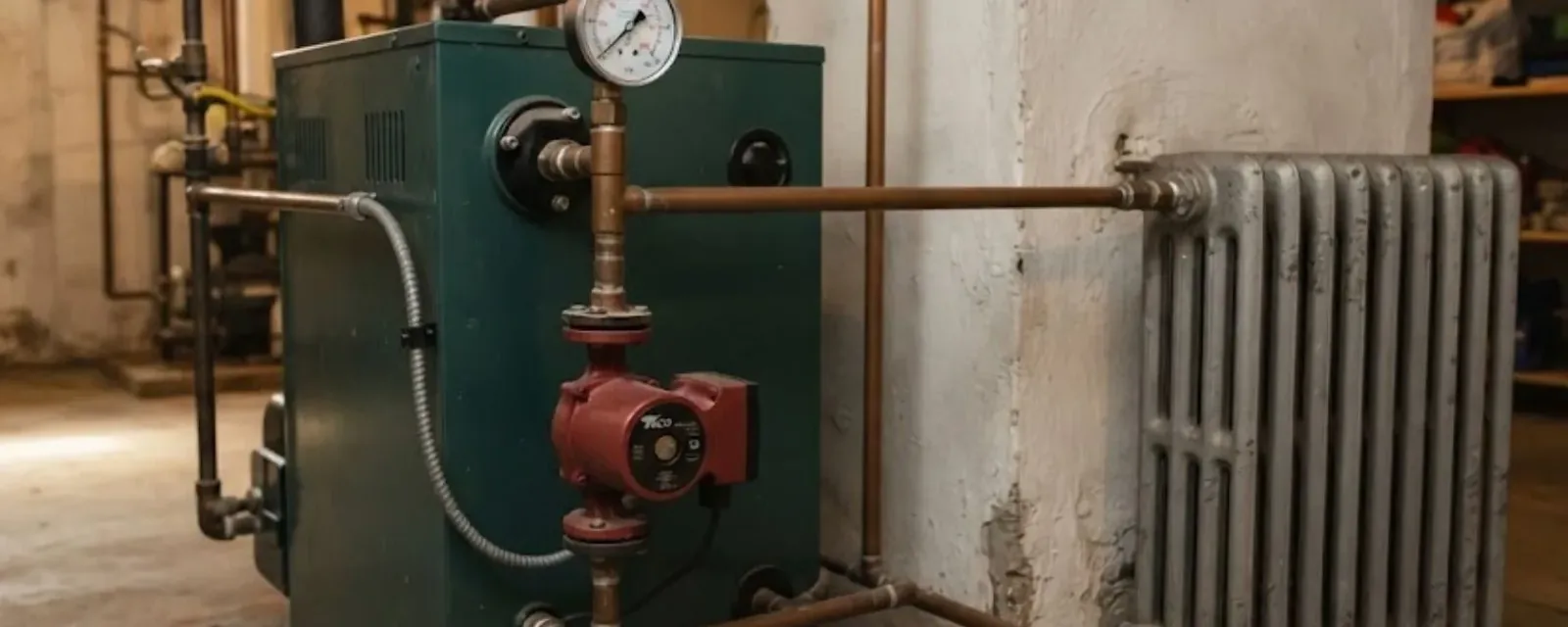
A boiler that has stopped heating usually fails for one of a few reasons: no fuel or power, low water pressure, a tripped safety control, trapped air or a failed pump. Each has its own clue. A clicking igniter, a pressure gauge near zero, radiators that are warm at the bottom and cold at the top, or a boiler that fires and shuts off within a minute all point in different directions.
This guide explains what those clues mean and which checks are safe for a homeowner. It also draws a line between plumbing and burner work, because some faults need a heating or fuel specialist, and a good plumber will say so.
If you smell gas, leave first
If you smell gas, leave the building right away and do not flip switches or use a phone inside. Call the gas utility or 911 from outside, and call a plumber only after they say it is safe. If a flood has reached the boiler, keep away from wet electrical areas and do not touch panels in standing water.
Symptoms, likely causes and who handles it
Use this to sort a symptom into a plumbing fault or a burner fault.
| Symptom | Likely cause | Safe homeowner check | Who handles it |
|---|---|---|---|
| No heat, boiler silent | Power switch off or tripped breaker | Check the boiler switch and breaker | Homeowner, then plumber. |
| Pressure gauge near zero | Leak or low fill | Read the gauge when the boiler is cold | Plumber. |
| Radiators cold at top | Trapped air | Bleed one radiator with the valve key | Homeowner or plumber. |
| Banging or kettling noises | Scale or low water flow | Note when the noise starts | Plumber. |
| Wet floor near the boiler | Leaking valve, pump or tank | Shut off the water feed, if known | Plumber. |
| Fires, then shuts off | Flame sensor, vent or control fault | Do not reset more than once | Burner or heating technician. |
If you do not know whether a fault belongs to the plumbing side or the burner side, a phone call can usually sort it out before anyone visits.
What the pressure gauge tells you
Most home boilers hold cold pressure around 12 to 15 psi, and the gauge sits on the front or side of the unit. Pressure that drifts toward zero means the system has lost water somewhere. A reading that climbs above about 25 psi when hot can point to a failing expansion tank, since the system has nowhere to store the heated water.
Do not keep adding water if the gauge falls every few days. A leak that is topped up quietly will corrode the boiler from inside. A pressure test or a visual check of joints and radiator valves finds the leak.
Checks you can safely do before calling
Take these steps in order, and stop if anything seems wrong.
Confirm power and thermostat
Check the boiler switch, the breaker, and that the thermostat is set to heat and above room temperature.
Read the pressure gauge
With the boiler cold, note the reading. Below about 10 psi, low pressure may be stopping the burner from firing.
Look for water
Check the floor, the relief valve discharge pipe and the pump flanges for drips or rust trails.
Bleed one radiator
Open the bleed valve a quarter turn with a key and close it when water appears. Re-check pressure after.
Reset once
If your unit has a reset button, press it once. If it locks out again, the fault is real and repeated resets can flood the chamber with fuel.
Photograph the fault code
Many boilers show a number or light pattern. A photo helps the technician arrive with the right part.
Common causes of repeat breakdowns
These keep returning when the root cause is not fixed.
Scale and sludge
Mineral deposits and rust slow heat transfer and cause noise. A system flush helps, and a water test shows how bad it is.
Failed circulator pump
The boiler heats but water does not move. Radiators stay cold even though the boiler is hot.
Faulty zone valve
One zone stays cold while others heat. The valve motor or the head has failed.
Bad expansion tank
Pressure spikes and the relief valve drips. The tank has lost its air charge or is waterlogged.
Blocked flue or vent
The boiler shuts off for safety. Do not bypass it. Have the venting inspected.
Repair, replace or upgrade: how to decide
A single failed part, such as a pump, valve or sensor, is usually worth repairing. A boiler with a cracked heat exchanger, repeated leaks from the block or a long record of costly repairs is a replacement candidate. Ask the technician for the failed part, the cause and whether it is likely to fail again.
Boiler replacement involves new piping, venting and sometimes a different fuel setup. Our boiler repair service handles the plumbing side of diagnosis, and larger changes fall under plumbing installation. Get any replacement quote in writing, with the equipment, labor and permit costs separated.
Questions to ask before you approve a repair
Good answers to these protect you from unneeded work.
- What exactly failed, and can you show me the part?
- Is the fault in the plumbing, the burner or the controls?
- Will you test pressure and check for leaks as part of the visit?
- Does this repair need a permit or an inspection?
- What happens to the warranty on the part and the labor?
- What would you replace next if this fails again?
What Neptune homeowners should know
Belmar has about 29.5 percent of its housing units vacant in the 2020 census numbers, which reflects a lot of seasonal and second homes. A shore house closed up for winter can sit with a boiler idle, so a drop in pressure or a slow leak may go unseen for weeks. Have the system checked before the first cold spell, and see our plumbing service in Belmar page for coverage.
Large parts of Neptune are in flood zones, including all of North Island. If water ever reached your boiler, its controls and burner need professional checking before any restart. Asbury Park sits between Wesley Lake and Deal Lake, so if you are there, our Asbury Park plumbing page covers the city.
Neptune Township's 2018 fee schedule lists $27 per plumbing fixture or device. Whether a boiler repair or swap needs a permit is a question for the township construction office, since permit rules vary. Confirm current fees with the office before you plan the work.
Source type: 2020 Census housing counts for Belmar, NJ DCA Strategic Recovery Planning Report (2014) and Neptune Township fee schedule
Questions about this topic
Air in the system, a failed circulator pump or a stuck zone valve are the usual causes. Bleeding a radiator takes a few minutes, and a pump or valve fault needs a plumber.
Only if your manual says so and the fill valve is clearly marked. Do not keep topping up, since repeated low pressure means a leak that needs to be found.
Leaks, pressure faults, pumps, valves and piping are plumbing work. Burner ignition, combustion tuning and fuel-side faults can belong to a heating or fuel specialist. Ask on the call which side your fault is on.
Yes, check the gauge, look for drips and ask for a pressure check before you need heat. A leak that started while you were away can drain the system.
Do not restart it. Keep out of standing water, leave the power off at the panel if it is safe to reach, and have the controls, burner and venting inspected.