
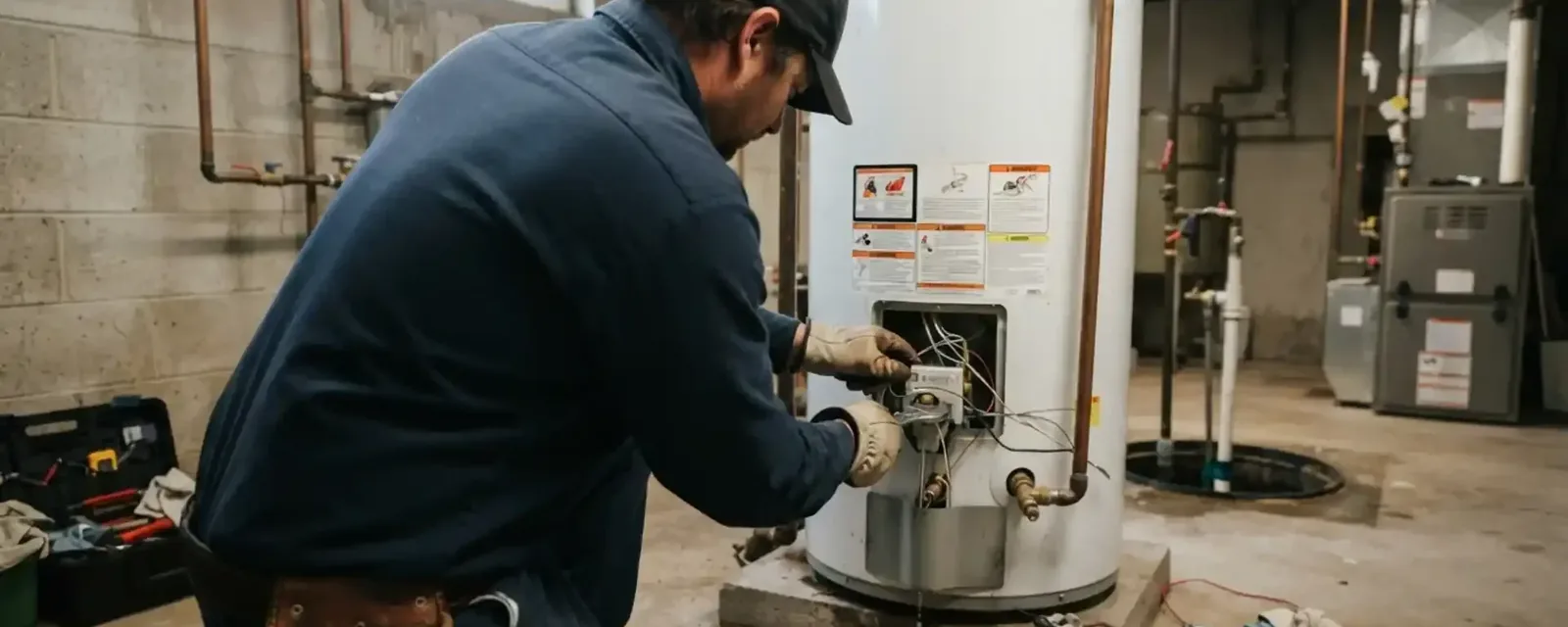
The cost of a water heater repair depends on which part failed, what fuel the heater uses, how old the tank is and how easy it is to reach. A heating element or thermostat is a small repair. A leaking tank is not a repair at all, because the steel shell cannot be patched.
This page does not list dollar figures, because the part, the labor and the access change from house to house. It does show the factors that move a quote up or down, so you can compare two estimates fairly and know when repair stops making sense.
Common failures and what shapes their cost
Parts differ widely in price and in the work needed to reach them. Here is how the usual failures compare.
| Problem | Typical fix | What drives the cost | Repair or replace? |
|---|---|---|---|
| No hot water, electric | Replace upper or lower element, or a thermostat | Part price and whether the tank must be drained | Repair, if the tank is sound. |
| No hot water, gas | Thermocouple, igniter or gas control valve | Valve cost is far above a thermocouple | Repair on a young tank, weigh it on an old one. |
| Water too hot or scalding | Thermostat or mixing valve | Simple part, but a safety item | Repair. |
| Dripping relief valve | Replace the temperature and pressure valve, check pressure | Part is small, cause may be thermal expansion | Repair, then find the cause. |
| Rotten egg odor | Replace the anode rod, flush the tank | Rod access can be tight | Repair on a young tank. |
| Water at the base of the tank | Find the source first | A leaking fitting is minor, a leaking tank is final | Replace if the shell leaks. |
Why the failed part matters most
Parts have very different price tags. An element or a pilot assembly sits at the cheap end. A gas control valve or a circulating pump costs far more, and on an older tank that price often tips the decision toward replacement.
Ask any plumber to name the failed part and show you why it failed. A test with a multimeter on an electric unit, or a check of the burner and flue on a gas unit, should back up the diagnosis. If the answer is a vague guess, get a second look.
Six factors that move a quote
When two quotes differ, one of these usually explains it.
Fuel type
Gas units add venting, gas valves and combustion safety checks. Electric units are simpler but hide the element behind panels and insulation.
Tank age
Past roughly a decade, most tanks are near the end of their life. Money spent on a repair may be lost if the shell fails next.
Access
A heater in a tight closet or attic takes longer to service than one in an open basement.
Parts availability
Common parts are in stock. A discontinued control board means a wait or a replacement.
Time of day
After-hours emergency calls cost more than a scheduled visit. Same-day appointments are offered when available.
Code items found
A missing discharge pipe or an unsafe vent has to be corrected before the unit runs. This is a safety requirement, not an upsell.
How to decide between repair and replacement
Use this order. It keeps the decision tied to the facts and not the pitch.
Check the age
The data plate on the tank has a serial number that encodes the build date. Ask the plumber to read it for you.
Find out if the tank leaks
Water pooling at the base from the shell means replacement. Leaks from a fitting or valve can be fixed.
Price the repair against a new unit
If the repair is a large share of a new heater, the new heater usually wins.
Consider your hot water needs
A tank that never kept up with the household is a reason to replace, even if it could be repaired.
Ask about warranty on the repair
Get the labor and part coverage in writing before work starts.
Safety first if you smell gas or see water
If you smell gas near a gas heater, leave the building and call the gas utility or 911 before you call a plumber. If water is pooling near an electric heater or panel, stay away from the wet area and never touch the panel while standing in water. Shut off the cold supply to the heater if you can reach it dry.
Getting quotes you can compare
Ask each company for the same things in writing: the part to be replaced, the labor, any code corrections, and what the repair is warranted for. A quote that lumps everything into one number makes comparison hard.
A plumber who gives a clear price before work starts lets you say yes or no with the facts. If the answer is repair, water heater repair in Neptune covers what the visit looks like. If the tank is finished, water heater replacement explains the swap.
What Neptune homeowners should know
New Jersey American Water reports naturally occurring hardness of 72 to 140 ppm as calcium carbonate in its Coastal North system, roughly 4 to 8 grains per gallon. That is the moderately hard to hard range, and your street may sit anywhere in it. Hard water leaves scale on elements and the tank floor, so an annual flush can extend the life of a tank and keep repair calls down.
The same report lists Neptune Township, Ocean Grove, Neptune City, Ocean Township, Asbury Park, Bradley Beach and Belmar among the communities served. In Ocean Township that means the same hardness range applies. In Belmar, water is billed through the borough's Water/Sewer Department, so a slow leak at a heater can show up on a quarterly bill late.
The state plumbing subcode defines hot water as 120 to 140 degrees F. If your heater is set far above that range, a thermostat check is worth doing before you replace anything.
Source type: NJ American Water Coastal North 2025 water quality report and NJ plumbing subcode (NSPC)
Questions about this topic
The usual causes are a different diagnosis, different parts, or one quote including code corrections the other left out. Ask both to name the failed part and itemize labor, parts and any added work.
Sometimes, if the repair is minor and the tank does not leak. A new element or thermostat on a dry, sound tank is reasonable. If the shell is rusted or weeping, replacement is the better choice.
Scale can build on elements and the tank bottom, which makes elements work harder and burn out earlier. The reported range of 72 to 140 ppm is in the moderately hard to hard band, so flushing the tank on a schedule makes sense.
The township's 2018 fee schedule lists $27 per plumbing fixture or device, including water heaters up to 99 gallons, and $65 for 100 gallons and up. Permit rules vary, so ask the Neptune Township construction office and confirm current fees.
That depends on your lease and local rules, so check the lease first. Take photos of the leak or failed part and send a written request to the landlord or property manager before any work.