
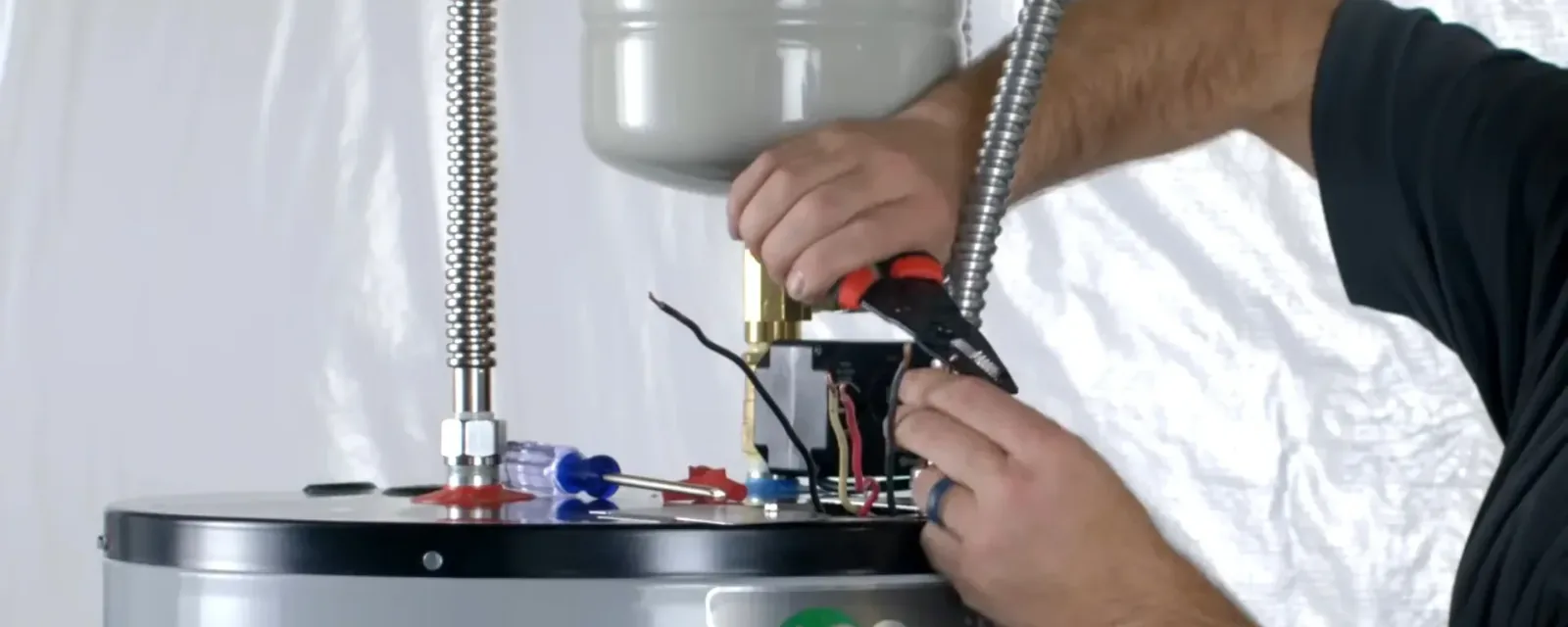
To replace a water heater element, turn off the breaker and confirm the power is dead with a tester. Close the cold inlet and drain the tank below the element. Remove the old element with an element wrench and fit a new one with a new gasket. Refill the tank completely before power goes back on.
People often ask whether you can do this without draining. You cannot, because the element sits inside the tank and removing it opens a hole to the water. The same goes for a dry element, which burns out in seconds if power reaches it without water. The steps below explain the test, the tools and the points where you should call a plumber.
Signs the element has failed
Electric tanks have two elements, upper and lower. Each fails differently.
No hot water at all
The upper element or the upper thermostat is often the cause, since the upper one heats first.
Hot water runs out fast
A dead lower element leaves only the top third of the tank heated.
Water stays lukewarm
A weak element, scale-coated element or a failing thermostat.
Breaker keeps tripping
A shorted element can trip the breaker repeatedly. Do not keep resetting it.
Crackling or popping
Scale on the element. Flushing may help but the element may be near the end.
Electrical safety comes first
Turn off the breaker for the heater and confirm with a voltage tester that the wires are dead before you touch anything. Stay away from wet floors around electrical equipment, and never touch a panel while standing in water. A water heater runs on 240 volts, which can seriously hurt you. If you are not comfortable, call a licensed plumber or electrician.
How to test an element with a multimeter
Test before you buy. A good element is cheaper than a wrong guess.
Cut power and confirm
Switch off the breaker, remove the access panel and insulation, and test the terminals for voltage.
Disconnect the wires
Take a photo, then remove the wires from the element terminals.
Set the meter to ohms
Touch the probes to the two terminals. A working element reads a low resistance, often 10 to 16 ohms for a 4500 watt unit.
Check for a short to ground
Touch one probe to a terminal and the other to the metal mounting flange. Any reading means the element is shorted.
Test the other element too
If one has failed, the other has seen the same age and scale.
Do you need to replace both elements?
Many plumbers replace both elements at once if the tank is already drained. The second element has the same age and the same scale exposure, and the extra part costs far less than a second drain and refill later. It is not required, so base the choice on your test results.
The thermostats are worth a look too. A failed thermostat or tripped high-limit reset button can mimic a dead element. Press the red reset button on the upper thermostat only after power is off and confirmed dead.
Draining and swapping the element
Drain below the element you are replacing. For the lower element that means draining the full tank.
Close the cold inlet
Shut the valve at the top of the tank so more water does not come in.
Open a hot tap upstairs
This lets air in so the tank can drain.
Attach a hose to the drain valve
Run it to a floor drain or outdoors. Draining takes a while, and the water will be hot.
Remove the old element
Fit an element wrench, usually 1-1/2 inches, and unscrew it counterclockwise.
Install the new element with a new gasket
Hand-thread it, then tighten. Match wattage and voltage to the label on the tank.
Refill and purge air
Close the drain, open the cold inlet, and leave the hot tap open until water runs steady. Check for leaks, replace insulation and the panel, then restore power.
Buying the right replacement
A wrong wattage or voltage can overload the circuit or leave the tank cold.
| Spec | What to match | Where to find it |
|---|---|---|
| Wattage | 4500 W is common on a 240-volt tank, but check yours | Rating plate on the tank. |
| Voltage | Usually 240 V | Rating plate on the tank. |
| Mount type | Screw-in or bolt-on flange | Look at the old element. |
| Element style | Standard, low-density or lime-resistant | Packaging at the store. |
| Upper or lower | Some units use different lengths | Compare with the old part. |
Gas heaters have no element
If your heater burns gas or oil, none of this applies. Gas units heat with a burner at the bottom, and no-hot-water calls there involve the pilot, thermocouple, igniter or gas valve. If you smell gas, leave the building and call the gas utility or 911 before you call a plumber.
Not sure which kind you have? Look for a thick electrical cable entering the top and a rating plate listing volts and watts. A flue pipe at the top and a gas line at the side means gas.
Why you cannot skip the draining
Unscrewing an element from a full tank sends a flood into your basement, and water in a basement near electrical gear is a risk. Draining also keeps the new element from sitting dry when power returns.
Never switch the power back on until the tank is completely full. A dry element can burn out in seconds. If your tank is old and rusted around the element opening, stop. A new element may not fix the problem, and water heater replacement may be the better choice. For a straightforward failed part, water heater repair in Neptune covers the service.
What Neptune homeowners should know
New Jersey American Water reports hardness of 72 to 140 ppm as calcium carbonate, roughly 4 to 8 grains per gallon, in the Coastal North system that serves Ocean Township, Bradley Beach and Neptune. Scale coats the lower element first, where it sits in the sediment. A yearly flush when you drain for an element job removes a lot of that buildup.
The state plumbing subcode defines hot water as 120 to 140 degrees F, so after a swap set the thermostat inside that range. Turning it higher costs more and raises scald risk.
Large parts of Neptune's residential areas sit in flood zones, including all of North Island. If an electric heater sat in floodwater, do not test it or restore power. Wait for a licensed professional. In Bradley Beach or Ocean Township, the local construction office can tell you whether a replacement tank or only an element swap needs a permit.
Source type: NJ American Water Coastal North 2025 water quality report and NJ plumbing subcode (NSPC)
Questions about this topic
No. The element is inside the tank, so removing it releases water. Drain below the element and refill fully before restoring power.
No hot water at all often points to the upper element or upper thermostat. Short hot supplies often point to the lower element. A multimeter test settles it.
Scale insulates the element and makes it run hotter, which shortens its life. With hardness in the 72 to 140 ppm range, a regular tank flush helps.
No. Leave the area, keep the breaker off if you can reach it dry, and call a professional. Wet electrical equipment can be energized in ways you cannot see.
Permit rules vary, so ask the Neptune Township construction office. A repair of an existing part is treated differently from installing a new heater.